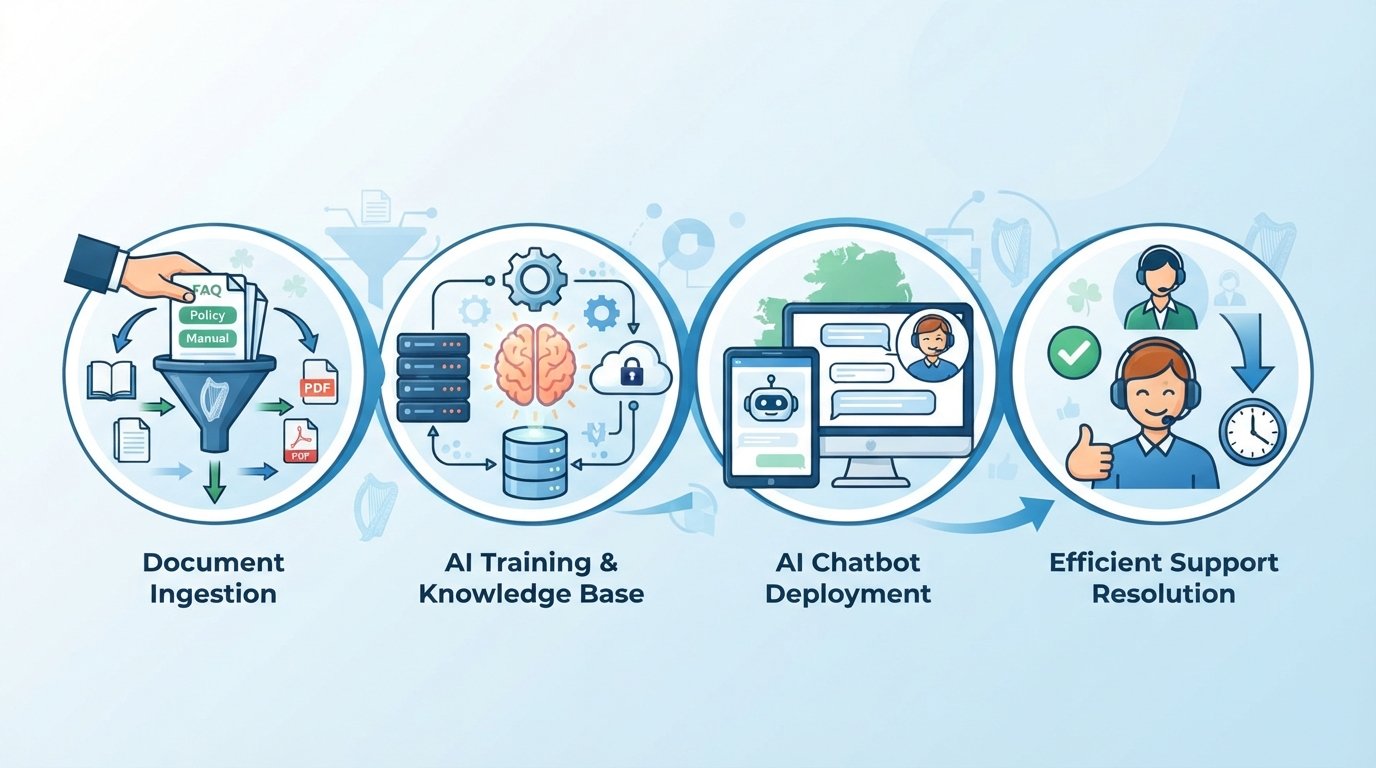
Streamline Irish Customer Support with a Document-Trained AI Chatbot
Introduction: Elevate Your Irish Customer Support with AI
In today's fast-paced digital landscape, providing exceptional customer support is non-negotiable for any successful Irish business. Customers expect instant answers, personalised interactions, and 24/7 availability. Meeting these demands with traditional methods can be resource-intensive, especially for small businesses juggling multiple priorities. This is where the power of a document-trained AI chatbot comes into play.
This comprehensive guide will walk you through the essential steps to successfully implement a document-trained AI chatbot, specifically tailored for your Irish business needs. You'll learn how to leverage your existing knowledge base – from FAQs and product manuals to internal policies – to create an intelligent AI assistant capable of handling a vast array of customer inquiries accurately and efficiently. By the end of this guide, you'll understand how to transform your customer service operations, reduce response times, free up your team for more complex tasks, and ultimately enhance customer satisfaction, all while maintaining compliance with local regulations. Unlock the potential of AI agents for small businesses Ireland and discover how this smart automation tool can be a game-changer for your growth.
Who This Is For
- Irish small and medium-sized enterprises (SMEs) looking to improve customer service efficiency.
- Business owners and managers seeking to reduce customer support costs and response times.
- Teams wanting to free up staff from repetitive queries to focus on high-value interactions.
- Companies aiming to provide 24/7 customer support without increasing headcount.
- Businesses interested in leveraging AI automation for small business Ireland to gain a competitive edge.
Step 1: Define Your Customer Support Goals and Scope
Before diving into any technology, it's crucial to clearly define what you aim to achieve with your AI chatbot and what specific areas of customer support it will address. A document-trained AI chatbot is powerful, but its effectiveness hinges on a clear understanding of its purpose and limitations. For Irish businesses, this means considering not just typical customer queries but also any local nuances or specific regulatory questions (e.g., related to consumer rights in Ireland).
Start by analysing your current customer support challenges. Are there repetitive questions consuming too much staff time? Do customers struggle to find information on your website? Is 24/7 support a priority? Identifying these pain points will help you scope the chatbot's initial capabilities and ensure it addresses your most pressing needs, making it one of the best AI automation tools for SMEs.
- Identify Key Pain Points: Review support tickets, emails, and call logs to pinpoint the most common and repetitive customer inquiries. Categorise them (e.g., product information, shipping, returns, billing).
- Set Clear Objectives: Decide what success looks like. Examples include "reduce support email volume by 30%", "improve average response time to under 1 minute", or "increase customer satisfaction scores by 10% for basic queries."
- Define Chatbot Scope: Determine which specific types of queries the chatbot will handle initially. Will it answer FAQs, provide product details, guide users through processes, or escalate complex issues?
- Consider Integration Needs: Think about where the chatbot will live (website, social media, internal tools) and what existing systems it might need to interact with (CRM, order management).
Tip: Focus on automating the "low-hanging fruit" first – the repetitive, easy-to-answer questions that consume significant agent time. This provides immediate ROI and builds confidence for expanding the chatbot's capabilities later.
Step 2: Curate and Organise Your Business Knowledge Base
The "document-trained" aspect of your AI chatbot means its intelligence comes directly from the information you provide. This step is perhaps the most critical for an effective AI agent. Your knowledge base is the brain of your chatbot, so it needs to be comprehensive, accurate, and well-structured. For Irish businesses, this might include specific Irish consumer law information, local delivery policies, or region-specific product details.
Gather all relevant documents that contain answers to potential customer questions. This could include your website's FAQ section, product manuals, service agreements, internal policy documents, training materials, and even past customer support email threads. The quality and breadth of this data will directly impact your chatbot's ability to provide helpful responses, positioning it as a top AI assistant for small business Ireland.
- Gather All Relevant Documentation: Collect every piece of information your business uses to answer customer questions. This includes public-facing content and internal guides.
- Standardise Information: Ensure consistency in terminology, product names, and policy explanations across all documents. Remove ambiguities or conflicting information.
- Organise and Categorise Data: Structure your documents logically. Use clear headings, bullet points, and concise language. Group related topics together for easier ingestion by the AI.
- Prioritise Accuracy and Up-to-Date Content: Outdated information is worse than no information. Regularly review and update your knowledge base to reflect current products, services, and policies.
- Convert to Machine-Readable Formats: Ensure documents are in formats easily processed by AI (e.g., plain text, well-structured PDFs, Word documents, web pages). Avoid image-only PDFs.
Warning: Never feed sensitive customer data or proprietary information that should not be publicly accessible into your general knowledge base without proper redaction and strict access controls. Always consider GDPR and data privacy implications, especially for an Irish audience.
Step 3: Select the Right AI Chatbot Platform for Irish Businesses
Choosing the right technology partner is paramount. While generic, off-the-shelf AI chatbot solutions exist, for Irish businesses, a custom-built, privacy-first, and locally supported solution often yields better results. This ensures the chatbot understands local nuances and integrates seamlessly into your existing workflows, avoiding the typical pitfalls of generic SaaS solutions.
Look for providers that specialise in custom AI agents and understand the unique requirements of the Irish market, including GDPR compliance. AISolutionsIreland, for example, offers solutions like OpenClaw, which provides private, secure, and fully-owned AI agents on a VPS, avoiding recurring AI agent subscription Ireland fees. This approach gives you greater control and security, which is critical when dealing with customer data.
- Evaluate Custom vs. Off-the-Shelf: Understand the trade-offs. Custom solutions offer tailored functionality, better integration, and often superior data privacy, which is vital for Irish SMEs.
- Prioritise Data Privacy and GDPR Compliance: Ensure your chosen platform adheres to the highest standards of data protection, especially given the strict EU AI Act and GDPR regulations in Ireland. This is a non-negotiable for any solution handling customer data.
- Consider Integration Capabilities: Does the platform offer APIs or connectors to your CRM, e-commerce platform, or other essential business tools? Seamless integration is key to true automation.
- Look for Local Support and Expertise: Partnering with a local provider like AISolutionsIreland ensures you receive personalised support that understands the Irish business context and local market needs.
- Understand Pricing Models: Compare subscription models with one-time setup fees plus pay-as-you-go usage (like OpenClaw) to find the most cost-effective solution for your budget.
Tip: Ask potential providers for case studies of successful implementations with other Irish businesses. This provides social proof and helps you assess their suitability for your specific context.
Step 4: Train Your AI Chatbot with Your Knowledge Base
This is where your meticulously curated knowledge base comes to life. Training your AI chatbot involves feeding it your organised documents so it can learn, understand, and retrieve information effectively. This process is often facilitated by your chosen AI solution provider, but understanding the principles helps you provide the best possible data.
The goal is to enable the chatbot to understand natural language queries from customers and match them to the most relevant information within your documents, providing accurate and contextually appropriate answers. This moves beyond simple keyword matching to genuine comprehension, making it a truly intelligent AI assistant for small business Ireland.
- Initial Data Ingestion: Upload your prepared documents to the AI platform. The system will process this data, creating an internal knowledge graph or embedding for quick retrieval.
- Refine and Tag Content: Work with your AI provider to refine how the AI interprets specific sections or answers. You might tag certain paragraphs as definitive answers to particular questions.
- Test with Real-World Queries: Start testing the chatbot with a diverse range of questions that customers might ask. Pay attention to how it interprets questions and the accuracy of its responses.
- Identify Gaps and Inaccuracies: During testing, you'll inevitably find questions the chatbot can't answer or answers incorrectly. This highlights gaps in your knowledge base or areas where the AI needs further tuning.
- Iterative Improvement: The training process is rarely a one-off. Continuously update your knowledge base and retrain the AI as new information becomes available or as you identify areas for improvement.
Warning: Resist the urge to over-engineer at this stage. Start with a solid foundation of your core documents and expand iteratively. Trying to perfect every single response before launch can lead to analysis paralysis.
Step 5: Design Chatbot Interactions and Escalation Paths
A smart chatbot isn't just about providing answers; it's about guiding the customer experience. This step involves designing the conversational flow, how the chatbot interacts with users, and crucially, how it handles situations it cannot resolve. For Irish businesses seeking AI agents, a smooth escalation process is key to maintaining customer satisfaction.
Think about the user journey. What happens if a customer asks something outside the chatbot's scope? Or if they express frustration? A well-designed chatbot provides helpful responses while also knowing when to gracefully hand over to a human agent, ensuring a seamless experience. This is part of what makes best AI agents for small businesses truly effective.
- Define Conversational Flow: Map out typical user queries and how the chatbot should respond, including potential follow-up questions to clarify intent.
- Craft Engaging Persona and Tone: Give your chatbot a friendly, professional, and on-brand voice. It should feel like a helpful extension of your Irish business.
- Implement Clear Escalation Paths: Crucially, define when and how the chatbot should transfer a conversation to a human agent (e.g., if it can't understand, if the user requests it, or after a certain number of failed attempts).
- Provide Self-Service Options: Beyond direct answers, can the chatbot direct users to relevant sections of your website, help them fill out forms, or initiate processes?
- Collect Feedback Mechanisms: Incorporate simple ways for users to rate the chatbot's answer (e.g., "Was this helpful? Yes/No") to gather valuable feedback for continuous improvement.
Tip: Start with a hybrid approach. Position the chatbot as a first line of defence, allowing it to handle common queries quickly, while always making it easy for customers to reach a human for more complex or sensitive issues. Transparency about when they are interacting with an AI is also crucial for trust.
Step 6: Deploy and Integrate Your AI Chatbot
With your chatbot trained and its interactions designed, it's time to deploy it to your chosen customer touchpoints. This step involves the technical implementation and integration into your existing website, messaging apps, or internal systems. AISolutionsIreland can help with rapid deployment, often within days, ensuring minimal disruption to your operations.
A key advantage of custom AI agents for small businesses is their ability to integrate deeply, moving beyond a simple pop-up widget to truly enhance your operational efficiency. Consider where your customers typically seek support and ensure the chatbot is readily available there.
- Website Integration: Embed the chatbot widget directly onto your business website. Consider placing it strategically on high-traffic pages, such as your contact page, product pages, or FAQ section.
- Messaging App Integration (Optional): If relevant for your audience, integrate the chatbot with platforms like Facebook Messenger, WhatsApp, or other popular messaging services in Ireland.
- CRM/Helpdesk Integration: Link the chatbot to your customer relationship management (CRM) system or helpdesk software. This allows for seamless transfer of conversation history when escalating to a human agent, providing them with full context.
- Testing End-to-End: Conduct thorough end-to-end testing to ensure the chatbot functions correctly across all integrated platforms, responds accurately, and escalates issues appropriately.
- Monitor Initial Performance: Immediately after deployment, closely monitor the chatbot's performance, paying attention to user interactions, common queries, and instances of escalation.
Warning: Ensure your website's performance is not negatively impacted by the chatbot's integration. Test loading times and responsiveness across different devices and browsers before a full public launch.
Step 7: Monitor, Analyse, and Iteratively Optimise
Deploying your AI chatbot isn't the finish line; it's the beginning of a continuous improvement journey. To maximise its effectiveness, you must actively monitor its performance, analyse user interactions, and use these insights to make ongoing improvements. This iterative process is what makes AI agents for small businesses Ireland truly valuable.
Regular analysis of chatbot conversations will reveal new common questions, areas where the chatbot struggles, or even emerging trends in customer inquiries. This data-driven approach allows you to continuously refine your knowledge base, improve the chatbot's responses, and expand its capabilities over time.
- Track Key Performance Indicators (KPIs): Monitor metrics such as query resolution rate, escalation rate, average interaction time, customer satisfaction scores (if collected), and the number of conversations handled.
- Review Chatbot Transcripts: Regularly review conversations where the chatbot struggled or escalated to a human. This is invaluable for identifying new questions or areas where the knowledge base needs updating.
- Update Your Knowledge Base: Based on your analysis, add new FAQs, refine existing answers, or update information that has become outdated. The more comprehensive and accurate your knowledge base, the better your chatbot performs.
- Refine Conversational Flows: Adjust the chatbot's dialogues, prompts, and escalation logic based on user behaviour and feedback to make interactions more intuitive and helpful.
- Solicit User and Agent Feedback: Gather direct feedback from customers who interact with the chatbot and from your support agents who handle escalated cases. Their insights are crucial for improvement.
- Explore New Features: As your chatbot matures, consider expanding its capabilities. Could it help with AI agents for email management, process simple transactions, or assist with AI agents for marketing automation?
Tip: Schedule regular "chatbot review meetings" with your support team and the AI provider. These sessions are excellent for sharing insights, identifying patterns, and strategising on the next steps for optimisation and expansion. Think of your AI chatbot as a growing asset, similar to how you manage your content or marketing efforts, even considering AI agents for content creation for small business as a separate project.
Common Mistakes to Avoid When Deploying an AI Chatbot
While the benefits of a document-trained AI chatbot are immense, certain pitfalls can hinder its success. Being aware of these common mistakes can help your Irish business navigate the implementation process more smoothly and ensure your investment yields the desired ROI.
- Underestimating Knowledge Base Preparation: The quality of your chatbot is directly tied to the quality of its training data. A poor or incomplete knowledge base will lead to frustrated customers and a perceived "dumb" chatbot.
- Expecting Human-Like Intelligence from Day One: AI chatbots are powerful tools, but they are not human. Set realistic expectations for what the chatbot can achieve, especially in its initial phases. It excels at specific, data-driven tasks, not general conversations.
- Ignoring Escalation Paths: Failing to provide clear and easy ways for customers to connect with a human agent when the chatbot can't help is a surefire way to alienate customers.
- Lack of Continuous Monitoring and Optimisation: A "set it and forget it" approach will lead to an outdated and ineffective chatbot. Regular review and updates are essential for long-term success.
- Neglecting Data Privacy and GDPR: For Irish businesses, ensuring strict compliance with GDPR and the EU AI Act is critical. Using non-compliant solutions can lead to severe penalties and loss of customer trust.
- Overcomplicating the Initial Scope: Trying to make the chatbot do too much too soon can overwhelm the implementation process. Start simple, prove value, and then expand.
- Failing to Inform Customers: Transparency is key. Let your customers know they are interacting with an AI. This manages expectations and builds trust.
- Not Integrating with Existing Systems: A standalone chatbot misses out on crucial opportunities for seamless customer journeys and efficient data transfer to human agents.
FAQ: Document-Trained AI Chatbots for Irish Businesses
How quickly can a document-trained AI chatbot be deployed for an Irish business?
The deployment timeline can vary based on the complexity of your knowledge base and the chosen platform. However, with a dedicated partner like AISolutionsIreland, you can expect rapid setup. Our OpenClaw service, for instance, aims for launch readiness within 24–48 hours for core functionalities, and full integration within days, not weeks. This speed ensures your Irish business can start benefiting from AI agents integration very quickly.
Is a document-trained AI chatbot compliant with GDPR and the EU AI Act?
Yes, absolutely. For Irish businesses, GDPR and the upcoming EU AI Act are critical considerations. AISolutionsIreland specifically designs its chatbots with privacy-first principles and ensures full compliance with GDPR and other relevant EU regulations. Our solutions, including OpenClaw, offer private and secure environments, giving you full ownership and control over your data. This is a core differentiator from generic AI agent subscription Ireland options.
What types of documents can be used to train an AI chatbot?
Virtually any text-based document can be used! This includes your website's FAQ pages, product manuals, service handbooks, internal training guides, company policies, terms and conditions, blog posts, and even transcripts of past customer interactions. The key is that the documents are clear, accurate, and contain the information you want your chatbot to convey. The better organised your documents are, the more effective your AI assistant for small business Ireland will be.
How does a document-trained chatbot handle questions outside its knowledge base?
A well-designed document-trained AI chatbot will recognise when a query falls outside its training data. In such cases, it should gracefully inform the customer that it cannot answer the specific question and offer alternative solutions. These solutions typically include escalating the query to a human agent, providing a contact form, or directing the customer to a different resource. This ensures a seamless transition and maintains customer satisfaction, a hallmark of best AI agents for small businesses.
Next Steps: Empower Your Business with Smart AI Agents
Implementing a document-trained AI chatbot is a strategic move that positions your Irish business for enhanced efficiency, improved customer satisfaction, and significant growth. Are you ready to transform your customer support and free up valuable time for your team? Explore how AISolutionsIreland can build custom AI agents tailored specifically for your needs, providing local design, personal support, and guaranteed GDPR/EU compliance.