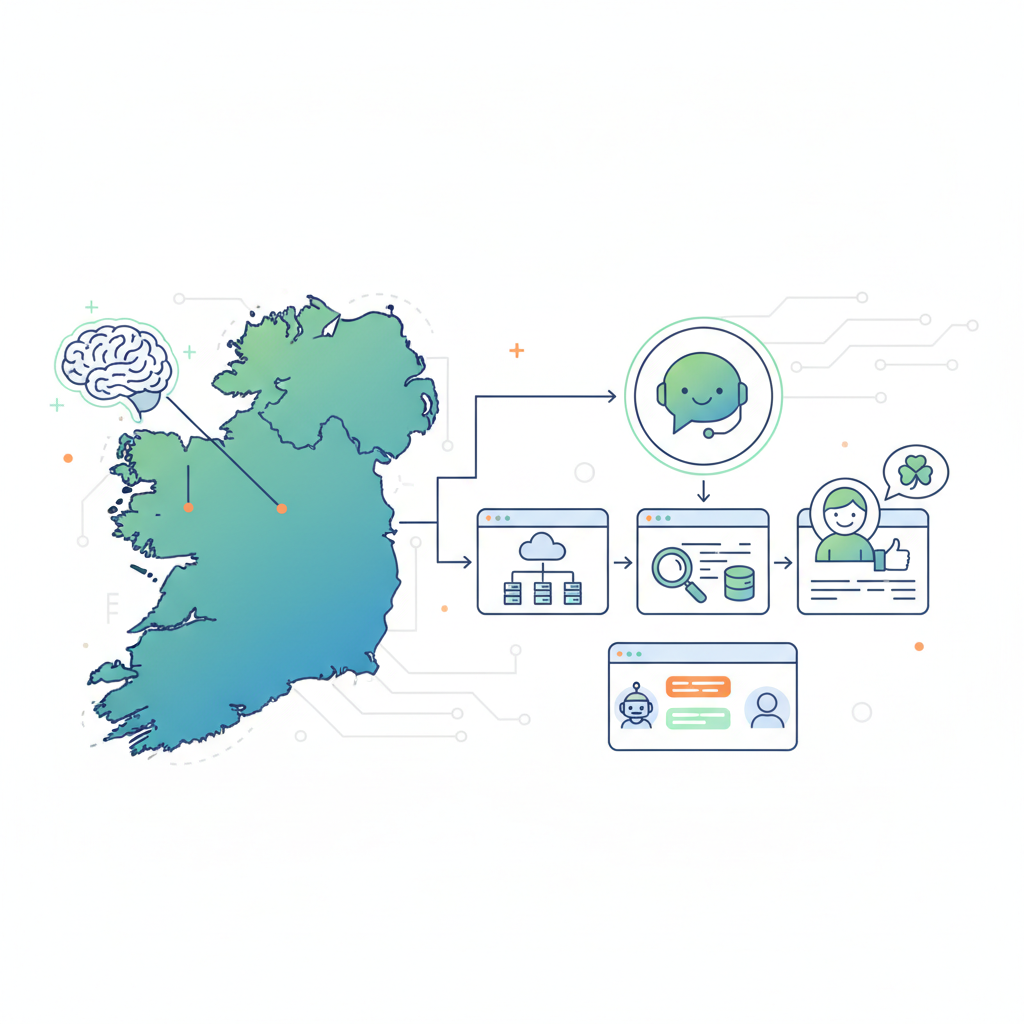
Deploy an AI Chatbot for Irish Customer Service: A How-To Guide
How to Deploy an AI Chatbot to Enhance Customer Service for Your Irish Business
In today's fast-paced digital landscape, customer service is no longer just a department; it's a cornerstone of business success and customer loyalty. For Irish businesses, meeting customer expectations means providing instant, accurate, and consistent support, often around the clock. This is where the power of Artificial Intelligence (AI) comes into play, specifically through the deployment of AI chatbots.
An AI chatbot isn't just a fancy tool; it's a strategic asset that can transform your customer interactions, streamline operations, and free up your human team to focus on more complex, value-driven tasks. Imagine offering 24/7 support without increasing your payroll, instantly answering frequently asked questions, or guiding customers through purchasing decisions with unparalleled efficiency. This guide will walk you through the essential steps to successfully deploy an AI chatbot tailored for your Irish business, from defining your needs to continuous optimisation.
You'll learn how to select the right AI solution, prepare your data, design engaging conversations, and integrate your new AI agent seamlessly into your existing workflows. By the end of this comprehensive guide, you'll have a clear roadmap to leveraging AI to not only enhance your customer service but also drive growth and build stronger relationships with your customers across Ireland. We at AISolutionsIreland are dedicated to helping local businesses harness these powerful AI solutions, ensuring they work the way you do, with local design and personal support.
Who This Is For
- Irish business owners looking to improve customer satisfaction and operational efficiency.
- Customer service managers seeking to reduce response times and handle query volumes more effectively.
- Marketing and sales teams aiming to qualify leads and provide instant information to potential customers.
- Entrepreneurs and startups in Ireland interested in implementing scalable customer support solutions from day one.
- Any business professional wanting to understand the practical steps of deploying an AI chatbot.
Step 1: Define Your Customer Service Goals and Scope
Before diving into technology, it’s crucial to understand why you need an AI chatbot and what specific problems it will solve for your Irish business. A clear vision ensures your chatbot project stays on track and delivers measurable value. Start by analysing your current customer service landscape.
Consider your busiest times, the most common questions your team receives, and any areas where customers frequently experience delays or frustration. This foundational step will help you determine the chatbot's primary function, whether it's answering FAQs, qualifying leads, guiding users, or providing technical support.
- Identify Key Pain Points: Pinpoint where your current customer service falls short. Are customers waiting too long for responses? Do your agents spend too much time on repetitive questions? Are there specific times when support is overwhelmed?
- List Common Customer Queries: Compile a comprehensive list of frequently asked questions, support tickets, and common requests. This data is invaluable for training your chatbot and defining its knowledge base. Categorise these by topic (e.g., product information, shipping, returns, billing).
- Set Clear, Measurable Goals: What do you want your chatbot to achieve? Examples include:
- Reduce call volume by X%
- Improve first-response time to Y seconds
- Increase customer satisfaction scores (CSAT) by Z%
- Automate X% of routine inquiries
- Generate X number of qualified leads per month
- Define the Chatbot's Scope: Decide what tasks your chatbot will initially handle. Start small and expand. Will it provide general information, troubleshoot simple issues, or route complex queries to human agents? Avoid trying to make it do everything at once.
Tip: Engage your customer service team in this initial phase. They are on the front lines and can provide invaluable insights into customer needs and common frustrations, ensuring the chatbot addresses real-world challenges.
Step 2: Research and Select the Right AI Chatbot Solution
With your goals defined, the next step is to choose the technology that best fits your business needs and budget. The market for AI chatbot solutions is diverse, offering everything from off-the-shelf platforms to custom-built AI agents. For Irish businesses, considerations like local support, data privacy (GDPR compliance), and ease of integration are paramount.
AISolutionsIreland specialises in providing bespoke AI solutions designed for local businesses, offering privacy-first, GDPR/EU compliant chatbots that are document-trained for fast, accurate responses. Our OpenClaw service, for instance, provides fully-owned, secure AI agents without recurring subscriptions, offering a unique value proposition for businesses seeking control and cost-effectiveness.
- Evaluate Solution Types:
- Rule-Based Chatbots: Follow pre-defined rules and scripts. Simpler to build but less flexible.
- AI/NLP-Powered Chatbots: Understand natural language, learn from interactions, and offer more dynamic conversations. These are ideal for enhancing customer service significantly.
- Custom-Built Solutions: Tailored exactly to your business processes and integrated deeply with your systems. This is where AISolutionsIreland excels, providing "AI that works the way you do."
- Key Features to Look For:
- Natural Language Processing (NLP): The ability to understand customer intent, even with varied phrasing.
- Integration Capabilities: Can it connect with your CRM, website, social media, or other business tools?
- Scalability: Can the solution grow with your business and handle increasing query volumes?
- Analytics & Reporting: Tools to monitor chatbot performance, user satisfaction, and identify areas for improvement.
- Human Handoff: A seamless way to transfer complex queries to a live agent when the chatbot can't resolve them.
- GDPR & Data Privacy: For Irish businesses, ensuring the solution is fully compliant with GDPR and EU data protection regulations is non-negotiable. Our chatbots are built with privacy in mind.
- Ease of Training: How easily can you feed new information and update its knowledge base? Document-trained solutions like ours make this process efficient.
- Consider Local Support: Opting for an Irish AI agency like AISolutionsIreland ensures you have access to local expertise and personalised support, understanding the unique nuances of the Irish market.
- Review Pricing Models: Be aware of one-time setup fees, subscription costs, usage-based fees, and any hidden charges. Our OpenClaw service offers a transparent one-time setup fee and pay-as-you-go usage, avoiding traditional recurring subscriptions.
Warning: Be wary of solutions that promise instant, magic results without requiring any data input or customisation. A truly effective AI chatbot needs to be trained on your specific business knowledge to be accurate and helpful.
Step 3: Gather and Prepare Your Training Data
The intelligence of your AI chatbot is directly proportional to the quality and quantity of its training data. This is where the "document-trained" aspect comes in, making your chatbot a true expert on your business. Think of your chatbot as a new employee who needs to learn everything about your products, services, policies, and customer interactions.
This step is foundational for building a chatbot that provides accurate, relevant, and helpful responses, truly enhancing your customer service. The more comprehensive and well-structured your data, the more effective your AI agent will be in resolving customer queries.
- Collect Existing Knowledge:
- FAQs: Your existing FAQ page is a goldmine.
- Knowledge Base Articles: Any internal or external documentation your team uses for support.
- Chat/Email Transcripts: Analyse past customer interactions to identify common questions, phrasing, and resolution paths.
- Product/Service Descriptions: Detailed information about your offerings.
- Company Policies: Information on returns, shipping, privacy, billing, etc.
- User Manuals/Guides: For technical products, these provide crucial details.
- Clean and Organise Your Data:
- Remove Redundancy: Eliminate duplicate information.
- Standardise Terminology: Ensure consistent language and phrasing across all documents.
- Update Information: Verify that all data is current and accurate. Outdated information can lead to frustrating customer experiences.
- Break Down Complex Information: Simplify long paragraphs into concise, digestible answers. Chatbots are best at delivering focused information.
- Categorise and Tag: Group related information together and tag it with relevant keywords. This helps the AI understand context and retrieve the right answer faster.
- Develop Q&A Pairs (Intents and Responses):
- For each common query (intent), craft a clear, concise, and helpful answer (response).
- Include variations of how a question might be asked. For example, "What are your opening hours?" "Are you open now?" "When do you close?" all map to the same intent.
- Ensure responses are consistent with your brand voice and provide actionable information.
- Consider Data Sensitivity: When collecting data, be mindful of any sensitive customer information. Ensure your data preparation process is GDPR compliant and only non-identifiable or publicly available data is used for general chatbot training unless specific, secure protocols are in place for personalised interactions.
Warning: "Garbage in, garbage out." Poorly prepared or inaccurate training data will result in a chatbot that gives incorrect answers, frustrates customers, and undermines your initial investment. Invest sufficient time in this phase.
Step 4: Design the Chatbot's Personality and Conversation Flow
Your AI chatbot isn't just a functional tool; it's a representative of your brand. Designing its personality and mapping out clear conversation flows are essential for creating an engaging and effective customer experience. This step ensures that interactions with your chatbot feel natural, helpful, and consistent with your brand identity.
A well-designed conversation flow anticipates user needs, guides them efficiently, and knows when to escalate to a human agent, all while maintaining a friendly and professional tone. This human-centric design approach is key to successful AI integration for business workflows.
- Define the Chatbot's Persona:
- Brand Voice: Should it be formal, friendly, witty, empathetic? Align its tone with your existing brand voice.
- Name (Optional): A friendly name can make interactions feel more personal.
- Limitations: Be transparent that it's an AI. This manages expectations and prevents frustration if it encounters a query it can't handle.
- Map Out Conversation Flows:
- Greetings and Introductions: How will the chatbot greet users? What information will it provide upfront?
- Common Query Paths: For your identified FAQs, design the step-by-step interaction. How will it ask clarifying questions? How will it deliver the answer?
- Error Handling: What happens if the chatbot doesn't understand a query? Design polite fallback responses that guide the user (e.g., "I'm sorry, I don't understand. Could you rephrase your question?").
- Escalation Paths (Human Handoff): This is critical. Define clear triggers for transferring to a live agent (e.g., specific keywords like "speak to a human," repeated failures to understand, complex issues). Collect necessary information before handover to save the customer time.
- Closing: How will the conversation end? Will it ask for feedback?
- Craft Engaging and Clear Responses:
- Conciseness: Keep answers brief and to the point.
- Clarity: Use simple language, avoiding jargon where possible.
- Action-Oriented: If a response requires an action (e.g., "click here," "fill out this form"), provide a direct link or clear instructions.
- Multimedia: Where appropriate, incorporate images, videos, or links to further resources to enhance understanding.
- Consider User Experience (UX):
- Buttons/Quick Replies: Offer pre-defined options for common next steps, making navigation easier for users.
- Context Retention: Can the chatbot remember previous parts of the conversation to provide more relevant responses?
- Accessibility: Ensure the chatbot interface is accessible to all users.
Tip: Create flowcharts or mind maps to visualise complex conversation paths. This helps ensure logical progression and identify potential dead ends or confusing interactions before implementation.
Step 5: Implement and Integrate the Chatbot with Your Platforms
Once your chatbot's brain (data) and personality (design) are ready, it’s time to bring it to life by implementing and integrating it across your customer touchpoints. This step involves the technical deployment, ensuring the chatbot can interact with your customers wherever they are and connect with your existing business systems.
For seamless AI automation for small business in Ireland, integration is key. Whether it's embedding a widget on your website or connecting to a CRM, the goal is to make the chatbot a natural extension of your service ecosystem.
- Website Integration:
- Widget/Plugin: Most chatbot platforms provide a simple code snippet or plugin to embed the chatbot widget directly onto your website.
- Placement: Choose a prominent but non-intrusive location, typically the bottom-right corner of the screen.
- Loading Speed: Ensure the chatbot script doesn't negatively impact your website's loading speed.
- Social Media Integration:
- Messaging Platforms: Integrate your chatbot with platforms like Facebook Messenger, WhatsApp, or Instagram Direct. Many platforms offer native integrations.
- Brand Consistency: Ensure the chatbot's persona and responses remain consistent across all channels.
- CRM and Other System Integrations:
- API Connections: For deeper integration, use APIs to connect your chatbot with your Customer Relationship Management (CRM) system, support ticketing software, or e-commerce platform.
- Data Exchange: This allows the chatbot to retrieve customer information, create support tickets, or update order statuses, providing a more personalised and efficient experience.
- Lead Qualification: If your chatbot is also for lead generation, ensure it can pass qualified leads directly into your sales pipeline.
- Seamless Handoff: When a human agent takes over, ensure they have access to the full conversation history from the chatbot for context.
- Internal Team Awareness:
- Train Your Agents: Educate your customer service team on the chatbot's capabilities, limitations, and the human handoff process. They should understand when and how to intervene.
- Internal Communication: Inform your team about the chatbot's launch and how it will change their workflow.
- Security and Compliance Checks:
- GDPR Assurance: Double-check all integrations for GDPR compliance, especially when connecting to systems that handle customer data.
- Data Encryption: Ensure data exchanged between the chatbot and other systems is encrypted and secure.
Warning: Poor integration can lead to fragmented customer experiences, data silos, and operational headaches. Test all connections thoroughly before a full public launch. If you're unsure about the technical aspects, engaging with expert AI solution providers like AISolutionsIreland can ensure a smooth, secure integration.
Step 6: Test, Refine, and Launch Your AI Chatbot
Launching an AI chatbot is an iterative process. Before a full public rollout, rigorous testing and refinement are paramount to ensure it performs as expected and delivers a positive customer experience. Think of it as a soft launch, allowing you to fine-tune the system in a controlled environment before it faces the general public.
This critical phase helps iron out kinks, improve accuracy, and optimise conversation flows, ensuring your AI workflow automation for SMEs truly enhances customer service.
- Internal Testing (Alpha Testing):
- Team Simulation: Have your internal team (customer service, marketing, product) interact with the chatbot as if they were customers.
- Scenario Testing: Test all planned conversation paths, including common FAQs, error handling, and human handoff scenarios.
- Edge Cases: Try asking unusual questions or phrasing queries in unexpected ways to test the chatbot's robustness.
- Feedback Collection: Document all issues, errors, unclear responses, and suggestions for improvement.
- User Acceptance Testing (UAT - Beta Testing):
- Pilot Group: Launch the chatbot to a small group of trusted customers or employees who are willing to provide detailed feedback.
- Real-World Scenarios: Allow the pilot group to use the chatbot for actual queries they might have.
- Feedback Mechanism: Provide an easy way for beta testers to submit feedback, report bugs, and rate their experience.
- Analyse Metrics: Monitor key performance indicators (KPIs) like resolution rate, human handoff rate, and session duration during this phase.
- Refinement Based on Feedback:
- Update Training Data: Based on testing results, refine your Q&A pairs, add new intents, or modify existing responses.
- Adjust Conversation Flows: Improve dialogue paths to make them more intuitive and efficient.
- Enhance NLP: Work on improving the chatbot's understanding of user queries, especially for common phrases it struggled with.
- Optimise Integrations: Ensure human handoffs are smooth and data exchange with other systems is reliable.
- Prepare for Launch:
- Final Checks: Conduct a final review of all features, integrations, and content.
- Marketing & Communication: Plan how you will announce the chatbot to your customers. Highlight its benefits and how it can help them.
- Monitoring Plan: Establish a plan for continuous monitoring post-launch (see Step 7).
- Phased Rollout:
- Consider a phased launch, starting with a specific department, product line, or customer segment before a full company-wide deployment. This allows for controlled learning and adjustment.
Warning: Rushing the testing phase can lead to a disastrous launch, resulting in frustrated customers and a negative perception of your AI solution. A thorough testing and refinement process is non-negotiable for success.
Step 7: Monitor Performance and Continuously Optimise
Deploying an AI chatbot is not a one-time project; it's an ongoing journey of monitoring, analysis, and continuous improvement. The real power of AI lies in its ability to learn and evolve. To maximise its value for your Irish business, you must dedicate resources to regularly review its performance and make necessary adjustments.
This iterative process ensures your chatbot remains a valuable asset, adapting to changing customer needs and business objectives. Through vigilant monitoring, your AI solutions will continue to deliver enhanced customer service and contribute to your overall AI benefits for Irish SMEs.
- Track Key Performance Indicators (KPIs):
- Resolution Rate: The percentage of queries the chatbot successfully resolves without human intervention.
- Human Handoff Rate: The percentage of conversations that require escalation to a live agent. High rates might indicate knowledge gaps or poor design.
- Customer Satisfaction (CSAT) Scores: Gather feedback after chatbot interactions (e.g., "Was this helpful?").
- Response Time: The speed at which the chatbot responds.
- Session Duration: How long users interact with the chatbot.
- Most Frequent Queries: Identify the most common questions customers ask.
- Unanswered Questions: Track queries the chatbot couldn't understand or answer. These are prime candidates for new training data.
- Analyse Chatbot Transcripts:
- Regularly review conversation logs to understand how users interact with the chatbot.
- Identify common misinterpretations, areas where the chatbot struggles, and opportunities for clearer responses.
- Look for patterns in user language and phrasing.
- Update Training Data and Knowledge Base:
- Fill Knowledge Gaps: Add new Q&A pairs based on unanswered questions and emerging customer needs.
- Refine Existing Answers: Improve clarity, accuracy, and conciseness of current responses.
- Keep Content Current: Update information about new products, services, or policy changes.
- Optimise Conversation Flows:
- Based on analytics, simplify complex paths, add quick reply options, or refine escalation procedures.
- Experiment with different wording or prompts to improve user engagement.
- A/B Testing:
- For critical parts of the conversation, test different chatbot responses or flows to see which performs better in terms of resolution rate or CSAT.
- Stay Informed on AI Advancements:
- The AI landscape evolves rapidly. Stay up-to-date with new features and capabilities from your chosen platform or partner (like AISolutionsIreland) to continually enhance your chatbot.
- Regular Reviews with Stakeholders:
- Periodically review chatbot performance and strategic direction with your customer service team, marketing, and leadership to ensure alignment with business goals.
Tip: Automate data collection and reporting where possible. Most modern chatbot platforms offer built-in analytics dashboards that make monitoring performance much easier. Set up alerts for specific performance metrics.
Common Mistakes to Avoid When Deploying an AI Chatbot
While the benefits of an AI chatbot are significant, pitfalls exist. Being aware of these common mistakes can help your Irish business navigate the deployment process more smoothly and achieve greater success.
- Lack of Clear Goals: Deploying a chatbot "just because" without defined objectives (e.g., reduce call volume, improve response time) makes it impossible to measure success or justify the investment.
- Poor Quality or Insufficient Training Data: A chatbot is only as good as the information it's fed. Inaccurate, outdated, or incomplete data leads to incorrect answers and customer frustration.
- Ignoring Human Handoff: Assuming the chatbot can handle every query is a recipe for disaster. A seamless, well-defined escalation path to a human agent is crucial for complex or sensitive issues.
- Over-Promising Capabilities: Setting unrealistic expectations for your chatbot (e.g., it will replace your entire customer service team) can lead to disappointment and negative customer perception.
- Neglecting Continuous Improvement: Launching and forgetting your chatbot will quickly render it obsolete. Ongoing monitoring, data updates, and refinement are vital for sustained performance.
- Creating a "Robotic" Experience: A chatbot with a poor personality or stilted language can alienate customers. Strive for a natural, helpful, and brand-consistent tone.
- Lack of Internal Team Buy-in: If your customer service team feels threatened or uninformed, they may resist the chatbot's integration, hindering its effectiveness. Involve them early and often.
- Ignoring GDPR and Data Privacy: For Irish businesses, failing to ensure your chatbot solution and its data handling practices are fully GDPR compliant can lead to significant penalties and loss of customer trust.
- Not Testing Thoroughly: Rushing the testing phase can result in a buggy chatbot that frustrates users from day one, damaging your brand reputation.
- Underestimating the Investment in Time: While AI automates tasks, the initial setup, training, and ongoing optimisation require dedicated time and resources, not just a monetary investment.
FAQ
What is an AI chatbot and how does it enhance customer service for Irish businesses?
An AI chatbot is a computer program designed to simulate human conversation through text or voice. For Irish businesses, it enhances customer service by providing instant, 24/7 support, answering frequently asked questions, guiding customers through processes, and handling routine queries. This frees up human agents to focus on more complex issues, leading to faster resolution times, improved customer satisfaction, and increased operational efficiency.
How long does it typically take to deploy an AI chatbot for an Irish SME?
The deployment time for an AI chatbot can vary significantly depending on its complexity and the amount of training data. For a basic, document-trained chatbot handling FAQs, it could be ready in a matter of days or weeks. More complex integrations with CRM systems or custom conversation flows might take a few weeks to a couple of months. Solutions like those offered by AISolutionsIreland are designed for fast setup, aiming for deployment in days, not weeks, especially for document-trained models.
Is an AI chatbot suitable for all types of Irish businesses?
While almost any business can benefit from some level of AI automation, AI chatbots are particularly impactful for businesses with high volumes of repetitive customer inquiries, a need for 24/7 support, or those looking to scale their customer service without proportional staffing increases. This includes e-commerce, retail, professional services, hospitality, and many B2B sectors. If your business spends significant time answering the same questions, an AI chatbot can be incredibly beneficial.
What about data privacy and GDPR compliance for AI chatbots in Ireland?
Data privacy and GDPR compliance are paramount for any AI solution operating in Ireland and the EU. When selecting an AI chatbot, it's crucial to ensure the provider adheres strictly to GDPR regulations, including how data is collected, stored, processed, and secured. AISolutionsIreland specifically designs its chatbots to be privacy-first and fully GDPR/EU compliant, offering solutions like OpenClaw that provide private, secure, and fully-owned AI agents, giving businesses complete control over their data.
Can an AI chatbot completely replace human customer service agents?
No, an AI chatbot is designed to augment, not replace, human customer service. While chatbots excel at handling routine, repetitive tasks and providing instant information, human agents remain indispensable for complex problem-solving, empathetic interactions, handling sensitive situations, and building long-term customer relationships. The most effective approach is a hybrid model where the chatbot handles the initial tier of support, seamlessly handing off to a human agent when necessary.
Next Steps
Ready to transform your customer service with intelligent AI agents tailored for your Irish business? At AISolutionsIreland, we specialise in building custom AI solutions that integrate seamlessly into your existing operations. Contact us today for a consultation and discover how our locally designed, personally supported AI chatbots can drive efficiency, enhance customer satisfaction, and fuel your business growth.