Build a Custom AI Chatbot for Irish Small Business Customer Support
In today's fast-paced digital world, providing exceptional customer support is no longer just a luxury; it's a necessity, especially for Irish small businesses looking to compete and thrive. With customers expecting instant responses and 24/7 availability, manually handling every query can quickly become overwhelming, impacting efficiency and growth. This is where a custom AI chatbot for your Irish small business steps in as a game-changer.
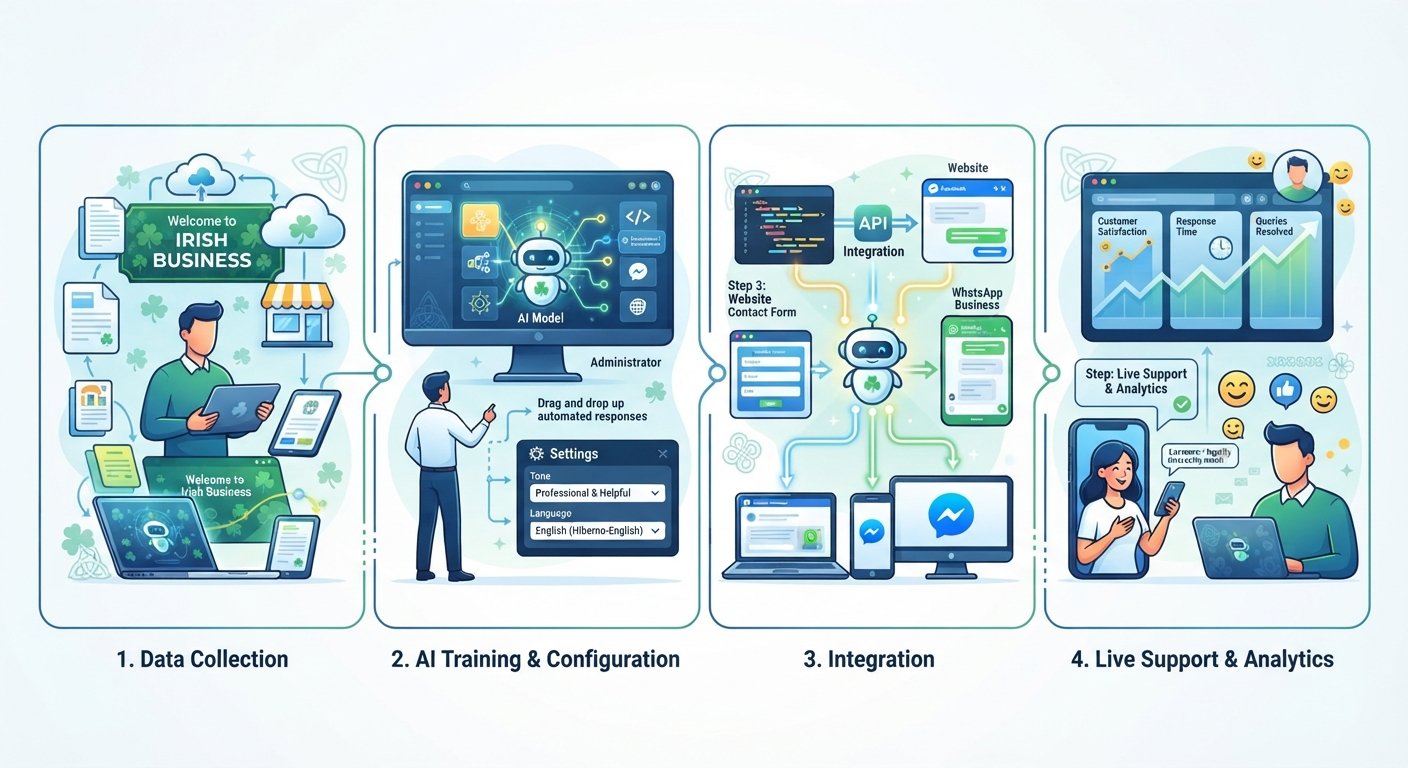
This comprehensive guide will walk you through the essential steps to design, build, and deploy an AI chatbot tailored specifically for your customer support needs. You'll learn how to leverage cutting-edge AI solutions to automate routine inquiries, free up your team for more complex tasks, and deliver a seamless experience to your customers, all while adhering to local nuances and privacy regulations. We'll cover everything from defining your chatbot's purpose to training it with your unique business data and integrating it into your existing systems. By the end of this guide, you'll have a clear roadmap to implement an effective AI assistant for your small business in Ireland, transforming your customer service operations and boosting your bottom line.
Embrace the power of AI automation tools in Ireland to streamline your customer experience and engagement, ensuring your business is always ready to assist, anytime and anywhere. Let's get started on building an AI-powered solution that works the way you do.
Who This Is For
- Irish small business owners seeking to enhance customer support and reduce workload.
- Entrepreneurs looking to automate repetitive queries and improve operational efficiency.
- Companies aiming to provide 24/7 customer service without increasing staffing costs.
- Businesses interested in leveraging AI solutions to boost growth and competitiveness in the Irish market.
Step 1: Define Your Chatbot's Purpose and Scope
Before diving into the technicalities of building a custom AI chatbot, the most crucial first step is to clearly define its purpose and scope. What specific problems do you want your chatbot to solve? Which aspects of your customer support will it handle? For an Irish small business, this often means addressing common queries related to opening hours, product availability, delivery times within Ireland, or local service specifics. A well-defined scope prevents feature creep and ensures your chatbot is effective, not just a novelty.
Consider the typical questions your customer service team receives. Are there frequent "where is my order?" inquiries, or do customers often ask about your returns policy? By identifying these pain points, you can design a chatbot that directly alleviates pressure on your staff and provides instant value to your customers. Think about the language your customers use and any specific Irish colloquialisms that might need to be understood or incorporated for a truly local and friendly experience. This initial strategic planning is the bedrock of a successful AI chatbot for Irish customer service.
- Identify Key Customer Service Pain Points: List the top 5-10 most frequent questions or issues your customer support team handles daily.
- Determine Core Functions: Decide what tasks your chatbot will perform, e.g., answering FAQs, providing product information, checking order status, basic troubleshooting, or redirecting to human agents.
- Set Clear Boundaries: Define what the chatbot won't do, such as handling sensitive personal data, processing payments, or resolving complex complaints that require human empathy.
- Consider Local Nuances: Think about specific Irish geographic, cultural, or business-related queries. Will it need to understand different regional accents if voice-enabled, or reference local holidays?
- Define Success Metrics: How will you measure the chatbot's effectiveness? (e.g., reduction in call volume, increased customer satisfaction scores, faster resolution times).
Step 2: Gather and Prepare Your Knowledge Base Data
The intelligence of your custom AI chatbot comes directly from the data you feed it. For an Irish small business, this means gathering all relevant information about your products, services, policies, and common customer queries. This data forms your chatbot's "brain" or knowledge base, enabling it to provide accurate and consistent responses. This step is particularly critical for ensuring your chatbot is truly custom and understands the specifics of your business, not just generic answers.
Your knowledge base should ideally include your website's FAQ section, product manuals, service descriptions, pricing policies, shipping information relevant to Ireland, and any internal documents that your customer service team uses. The quality and comprehensiveness of this data directly impact the chatbot's performance. Furthermore, with GDPR and EU data privacy regulations being paramount in Ireland, it's essential to ensure all data collected and used for training is compliant. AISolutionsIreland specifically designs privacy-first & GDPR/EU compliant chatbots, making this aspect easier for local businesses.
- Compile Existing Information: Collect all current FAQs, support articles, product descriptions, company policies (returns, shipping, privacy), and any other relevant customer-facing information.
- Standardise and Organise Data: Structure your information clearly and consistently. Break down complex answers into digestible chunks. Use clear headings and bullet points.
- Create New Content if Needed: If there are gaps in your existing knowledge base for common queries, write clear and concise answers.
- Annotate for Context: For more advanced AI, consider annotating data with relevant keywords or categories to help the AI understand the context of queries.
- Ensure Accuracy and Freshness: Regularly review and update your knowledge base to ensure the information is always current and correct. Outdated information can severely impact chatbot performance and customer trust.
- Address Irish Specifics: Include details like Irish bank holidays, local delivery partners, regional variations in product names (if applicable), or common Irish queries.
Step 3: Choose Your AI Chatbot Platform or Partner
With your purpose defined and data prepared, the next critical decision is how you'll actually build the chatbot. You have two primary paths: using an off-the-shelf platform (which may still allow for customisation) or partnering with an expert like AISolutionsIreland for a bespoke solution. For Irish small businesses, choosing the right approach can significantly impact development time, cost, and the overall effectiveness of your custom AI chatbot.
Off-the-shelf platforms offer speed and lower initial investment but might limit deep customisation, brand voice, or integration with specific Irish business systems. A custom development partner, on the other hand, can create a solution perfectly aligned with your unique workflows, local market needs, and long-term strategic goals. This is particularly valuable for businesses seeking bespoke AI agents over generic SaaS, ensuring the AI works exactly the way you do.
- Evaluate Off-the-Shelf Platforms: Research popular AI chatbot builders (e.g., Google Dialogflow, IBM Watson Assistant, HubSpot Chatbot Builder). Look for ease of use, integration capabilities, pricing models, and whether they support the languages and features you need.
- Consider Custom Development: For highly specific needs, unique branding, or complex integrations, a custom-built solution might be more suitable. This allows for complete control over functionality and data security.
- Partner with Local AI Experts: Engage with Irish AI solution providers like AISolutionsIreland. We specialise in building custom AI agents and automated workflows specifically for Irish businesses. Our OpenClaw - Clawd Bot Managed Implementation Service, for example, offers private, secure, and fully-owned AI agents hosted on a VPS with a zero-trust VPN, avoiding recurring subscriptions with a one-time setup fee (€199). This option ensures local design, personal support, and GDPR compliance, which is invaluable for Irish SMEs.
- Assess Integration Capabilities: Ensure your chosen platform or partner can seamlessly integrate the chatbot with your existing website, CRM (e.g., Salesforce, HubSpot), and other communication channels.
- Review Support and Scalability: Consider the level of technical support provided and whether the solution can scale as your business grows and your chatbot's functions expand.
Step 4: Design the Conversation Flow and User Experience
The effectiveness of your custom AI chatbot isn't just about its technical capabilities; it's heavily influenced by how intuitively and naturally users can interact with it. Designing a logical conversation flow and a positive user experience (UX) is crucial for an AI agent that understands local workflows and nuances. This step focuses on mapping out how your chatbot will guide users through their queries, from initial greeting to resolution or escalation.
Think like your customer. What questions do they ask? How do they phrase them? Anticipate different user paths and potential misunderstandings. A well-designed flow should be clear, concise, and offer options when the chatbot isn't sure. For an Irish audience, incorporating a friendly and approachable tone, perhaps with a touch of local charm, can significantly enhance the user experience and make interactions feel more personal and less robotic.
- Map Out User Journeys: For each core function identified in Step 1, create a flowchart or diagram illustrating how a user would interact with the chatbot to achieve their goal.
- Craft Engaging Greetings and Closings: Develop a warm, branded introduction and a helpful, polite closing. For Irish businesses, consider a friendly "Céad Míle Fáilte" or a simple "Thanks for getting in touch!"
- Write Clear and Concise Responses: Avoid jargon. Use simple, direct language. Ensure responses are consistent with your brand voice.
- Anticipate User Intent and Variations: Design for different ways users might ask the same question. For example, "What are your hours?" vs. "When do you open/close?"
- Implement Decision Trees/Options: For complex topics, provide multiple-choice options to guide the user and narrow down their query, reducing ambiguity.
- Define Escalation Paths: Clearly outline when and how the chatbot should hand over to a human agent, providing the human with context from the conversation. This is vital for customer satisfaction when the AI reaches its limits.
- Incorporate Error Handling: Design responses for when the chatbot doesn't understand a query. Offer to rephrase, suggest common topics, or provide an immediate escalation option.
Step 5: Train and Fine-Tune Your AI Chatbot
Once your chatbot's logic and conversation flows are designed, it's time to infuse it with your specific knowledge. This training phase is where your prepared data from Step 2 becomes actionable, transforming your chatbot from a shell into an intelligent assistant. For a custom AI chatbot for an Irish small business, this means training it not only on your business's unique information but also ensuring it comprehends the nuances of local queries and language.
Training an AI chatbot is an iterative process. It involves feeding the AI with example questions and their corresponding correct answers, along with different phrasings of the same questions (called "utterances"). The more diverse and comprehensive your training data, the better your chatbot will become at understanding user intent and providing accurate responses. Regular fine-tuning based on actual user interactions is crucial for continuous improvement and achieving the best AI automation for Irish companies.
- Input Knowledge Base Data: Upload your structured FAQs, policies, and product information into your chosen chatbot platform. This is the core dataset the AI will learn from.
- Provide Training Phrases (Utterances): For each question your chatbot is designed to answer, provide numerous variations of how a user might ask it. Include synonyms, common misspellings, and different sentence structures.
- Define Intents: Group similar user questions under "intents" (e.g., "Order Status," "Returns Policy," "Opening Hours"). Link each intent to the appropriate response or action.
- Extract Entities: Configure the chatbot to identify key pieces of information within a user's query, such as "product name," "order number," or "location." This allows for more dynamic and personalised responses.
- Test Extensively: Run comprehensive tests using a wide range of realistic queries. Include questions outside the chatbot's intended scope to see how it handles them and where its knowledge gaps lie.
- Analyse and Refine: Review chatbot transcripts regularly. Identify common failures, unclear responses, or instances where the chatbot misunderstood the user. Use this feedback to add more training data, refine existing responses, or adjust intent definitions.
- Monitor Performance Metrics: Track metrics like resolution rate, handover rate, and user satisfaction to gauge effectiveness and pinpoint areas for improvement.
Step 6: Integrate the Chatbot into Your Business Channels
A custom AI chatbot is only as effective as its accessibility. Once it's trained and refined, the next step is to seamlessly integrate it into the customer-facing channels where your Irish small business interacts with its audience. This ensures that customers can easily find and use the chatbot, allowing it to begin automating support queries and freeing up your team.
The primary integration point is typically your website, but consider other channels where your customers seek support, such as social media platforms, messaging apps, or even within your CRM system for internal use. The goal is to make the chatbot a natural and intuitive part of your customer's journey, enhancing the overall customer experience without creating new barriers.
- Website Integration: Embed the chatbot widget directly onto your business website. This often appears as a small chat icon in the corner of the screen. Ensure it's visible but not intrusive.
- CRM Integration: Connect your chatbot with your Customer Relationship Management (CRM) system (e.g., Salesforce, Zoho, HubSpot). This allows the chatbot to retrieve customer information for personalised responses and log interactions for human agents. AISolutionsIreland offers seamless AI integration services for CRM in Irish businesses.
- Social Media & Messaging Apps: Explore integrating your chatbot with platforms like Facebook Messenger, WhatsApp, or Instagram Direct Messages, depending on where your target Irish audience spends their time.
- Email Integration (Optional): For specific use cases, a chatbot can even respond to simple email queries, especially those related to FAQs or general information. This can be a part of broader AI agents for email management.
- Test Integrations Thoroughly: After integration, rigorously test the chatbot on each platform to ensure it functions correctly, loads quickly, and maintains its intended conversation flow across different devices and browsers.
- Inform Your Customers: Announce the launch of your new AI chatbot to your customers. Explain its purpose and how it can help them get faster answers.
Step 7: Launch, Monitor, and Continuously Improve
Launching your custom AI chatbot is not the end of the journey; it's just the beginning. The real value of an AI assistant for your small business in Ireland comes from continuous monitoring, analysis, and improvement. Post-launch, your chatbot will encounter a vast array of real-world queries, some of which it may not have been specifically trained for. This live data is invaluable for enhancing its performance and ensuring it remains a highly effective AI automation tool.
Establish a routine for reviewing chatbot performance metrics and user feedback. This iterative process ensures your chatbot evolves with your business and customer needs, becoming an increasingly powerful asset for your customer support operations. By actively engaging in this continuous improvement cycle, you ensure your affordable AI agents for small businesses continue to deliver value.
- Soft Launch (Internal or Small Group): Consider an internal soft launch within your team or with a small group of beta testers before a full public release. This allows for final tweaks in a controlled environment.
- Monitor Performance Analytics: Regularly review key metrics provided by your chatbot platform:
- Resolution Rate: Percentage of queries resolved by the chatbot without human intervention.
- Handover Rate: How often the chatbot escalates to a human agent.
- Fallback Rate: How often the chatbot fails to understand a query.
- User Satisfaction (if collected): Direct feedback from users on their experience.
- Most Frequent Queries: Identify what users are asking most often.
- Top Unanswered Questions: Pinpoint knowledge gaps.
- Analyse Chat Transcripts: Manually review a sample of conversations, especially those that ended in a handover or a fallback. This provides qualitative insights into why the chatbot struggled.
- Gather User Feedback: Implement a simple feedback mechanism (e.g., a "Was this helpful?" thumbs up/down button) at the end of chatbot interactions.
- Update Knowledge Base and Training Data: Based on your monitoring and analysis, update your knowledge base and add new training phrases to improve the chatbot's understanding and response accuracy.
- Iterate and Retrain: Regularly push updates and retrain your AI model with new data. Treat your chatbot as a living entity that requires ongoing care and development.
- Stay Informed: Keep an eye on new AI models and capabilities. AISolutionsIreland frequently shares updates on how new AI models ignite personalised agents for Irish SMEs, helping you stay ahead.
Common Mistakes to Avoid
While building a custom AI chatbot for your Irish small business offers immense benefits, several pitfalls can hinder its effectiveness. Being aware of these common mistakes will help you navigate the development process more smoothly and ensure your investment yields the best possible returns.
- Unrealistic Expectations: Expecting the chatbot to solve all customer service problems immediately. AI chatbots are powerful but have limitations. They excel at repetitive tasks but often struggle with highly complex, emotional, or novel queries.
- Lack of Clear Scope: Trying to make the chatbot do too much at once. This leads to an unfocused, underperforming chatbot that confuses users. Start with specific, high-value tasks and expand gradually.
- Insufficient Training Data: A chatbot is only as good as the data it's trained on. Poorly structured, incomplete, or outdated knowledge bases will result in inaccurate or unhelpful responses, frustrating customers.
- Ignoring Local Nuances: Failing to account for Irish specific language, cultural references, or business practices can make the chatbot feel generic and less helpful to local customers.
- Poor Conversation Design: A clunky, overly robotic, or confusing conversation flow will quickly disengage users. Prioritise a natural, intuitive, and user-friendly experience.
- No Human Handover: Not providing a clear and easy path to speak with a human agent when the chatbot can't help is a major source of frustration. The chatbot should augment, not replace, human support.
- Set-It-and-Forget-It Mentality: Launching the chatbot and then ignoring its performance. Without continuous monitoring, analysis, and refinement, your chatbot will quickly become outdated and ineffective.
- Disregarding Data Privacy: Failing to comply with GDPR and Irish data protection regulations when collecting and processing data for chatbot training and operation can lead to severe penalties and reputational damage.
FAQ
How quickly can an AI chatbot be implemented for an Irish SME?
The implementation timeline for a custom AI chatbot for an Irish SME can vary based on complexity. For basic FAQ chatbots using existing data, it could be ready within days. More complex custom solutions requiring extensive data integration and bespoke features might take a few weeks. Providers like AISolutionsIreland aim for fast setup times, often in days, not weeks, to get businesses up and running quickly.
What are the typical costs associated with a custom AI chatbot for an Irish small business?
Costs for a custom AI chatbot can vary widely. Factors include the chosen platform (DIY vs. managed service), the complexity of features, the volume of data for training, and integration requirements. AISolutionsIreland offers solutions like OpenClaw with a one-time setup fee (€199) plus pay-as-you-go usage, providing an affordable alternative to recurring subscriptions. It's best to discuss your specific needs for a tailored quote, as outlined in understanding the costs of AI agent solutions for Irish SMEs.
How does a custom AI chatbot handle Irish-specific queries or accents?
A truly custom AI chatbot is trained on your specific business data, which includes the language, products, and services relevant to your Irish customer base. For text-based chatbots, the training data should reflect common Irish phrasing and queries. For voice-enabled chatbots, advanced AI models can be fine-tuned to better understand various accents, though perfect comprehension across all dialects can be challenging. Working with a local Irish AI agency can ensure these local nuances are effectively addressed in the chatbot's design and training.
Is a custom AI chatbot GDPR compliant for Irish businesses?
Yes, a custom AI chatbot can and should be GDPR compliant. When partnering with a reputable AI solutions provider like AISolutionsIreland, GDPR compliance is a core consideration. This involves ensuring data is processed legally, transparently, and securely, with measures like data minimisation, anonymisation, and secure hosting (e.g., on a private VPS with zero-trust VPN) in place. It's crucial to confirm these aspects with your provider, as detailed in how AISolutionsIreland ensures AI data privacy & GDPR compliance.
What if my chatbot can't answer a customer's question?
A well-designed custom AI chatbot will always have a robust escalation path to human support. When the chatbot encounters a query it doesn't understand or can't resolve, it should seamlessly transfer the customer to a live agent, providing all the context of the previous conversation. This ensures that customers always get their questions answered, maintaining high satisfaction levels and upholding the quality of your customer service.
Next Steps / CTA
Ready to transform your customer support and bring the power of AI to your Irish small business? Explore our tailored AI solutions and discover how a custom AI chatbot can elevate your business efficiency and customer satisfaction. Contact AISolutionsIreland today to discuss your specific needs and take the first step towards smarter automation.