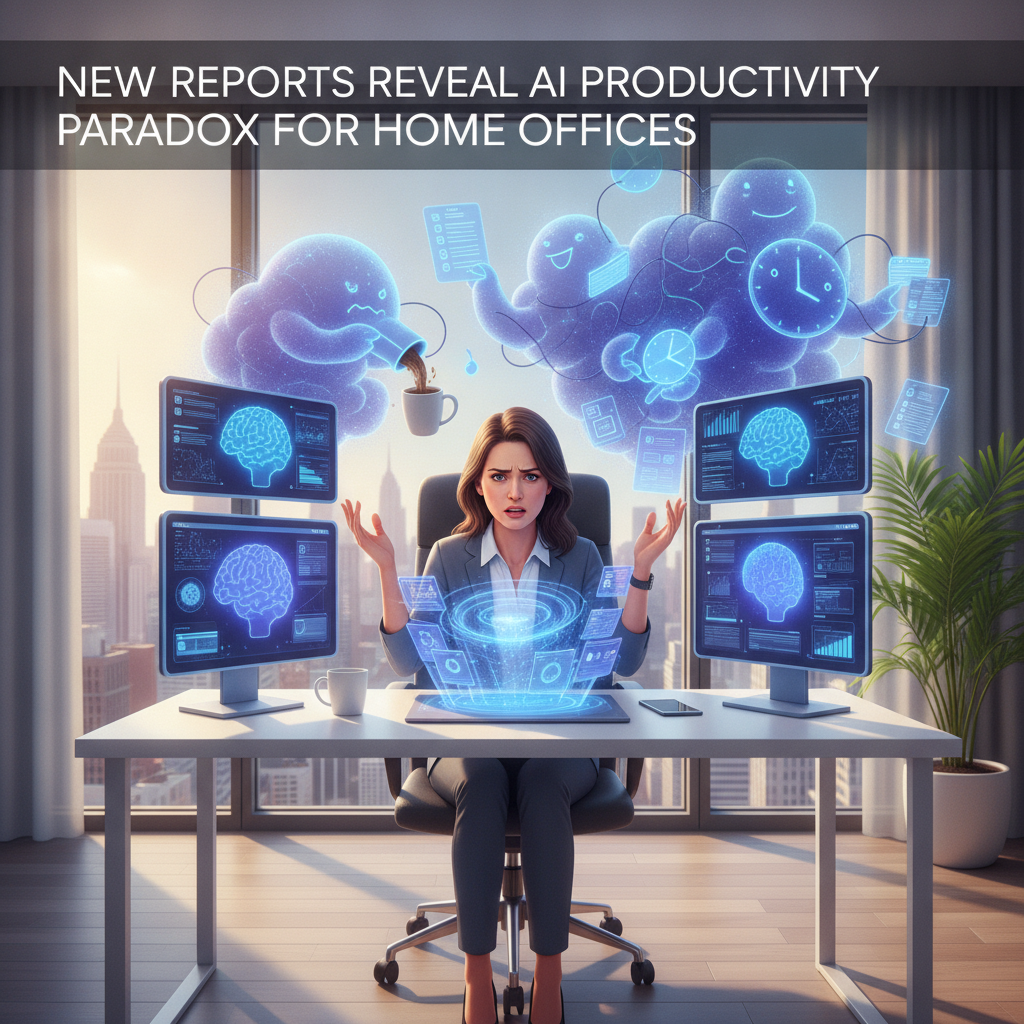
New Reports Reveal AI Productivity Paradox for Home Offices
New Reports Highlight AI's Dual Impact on Home Office Productivity
Recent authoritative reports from the Glean Work AI Institute, McKinsey, and PwC have collectively painted a nuanced picture of the evolving role of AI agents for home office productivity. While these advanced tools promise unprecedented efficiency for Irish businesses and solo entrepreneurs, a new phenomenon dubbed "botsitting" is emerging, revealing hidden labour costs associated with poorly implemented AI. Conversely, strategic adoption of ai agent tools for small businesses is demonstrating transformative gains, redefining sales, admin, and workflow automation.
The "Botsitting" Reality: A Hidden Productivity Drain
A groundbreaking report from the Glean Work AI Institute, in collaboration with researchers from Notre Dame, Stanford, and UC Berkeley, has introduced the term "botsitting" to describe the significant human effort still required to make AI agents truly effective. Home-based white-collar workers are now spending an average of 6.4 hours per week "botsitting" their AI agents—equivalent to most of a full working day. This involves feeding AI agents context, meticulously checking outputs, debugging mistakes, and correcting errors, rather than enjoying autonomous task completion.
The report starkly warns that workers spending an unusually large share of their AI time on botsitting are 73% more likely to be actively seeking new employment. For Irish businesses leveraging personal ai assistant for productivity or ai agents for admin tasks small business, this highlights a critical need for proper integration and training to ensure AI enhances, rather than burdens, employee satisfaction and retention. This isn't a failure of AI, but a call for more intelligently designed and managed AI solutions.
The "AI Agent Factory" Model: Resizing Teams and Accelerating Workflows
In stark contrast to the "botsitting" challenge, McKinsey’s recent 8-page guide outlines an "AI agent factory model" that is already being adopted by small businesses and home offices globally. This model demonstrates the potential to dramatically reshape team structures and project timelines, replacing up to 60% of traditional development teams. By adopting this approach, a team of 100 Full-Time Employees (FTEs) could be reduced to 60, while compressing 200 person-years of work into just 100 person-years.
The "24-Hour Sprint Model" championed by McKinsey envisions humans working 8 hours daily to review AI outputs, set guardrails, and align priorities, with ai agents for workflow automation examples executing the remaining 16 hours autonomously overnight—handling requirements, architecture, code, and testing. This model presents a massive opportunity for Irish SMEs to achieve ai workflow automation for small business, enabling them to scale operations and accelerate development without needing to exponentially increase headcount.
Agentic Front Office: Revolutionising Sales and Customer Interaction
Further data from PwC and Gartner underscores the transformative impact of ai agents for sales automation and front office functions. These insights are particularly compelling for Irish small businesses aiming to grow revenue and manage costs more effectively. Early AI adopters are reporting cuts in front-office operational costs by up to 40%, while simultaneously boosting revenue.
Gartner's Sales Survey reveals that AI-enabled sellers are 3.7 times more likely to meet their quotas. PwC clients have experienced a 10–20% revenue lift per sales rep and a significant 30–50% reduction in service costs. The future looks even more agent-driven, with Gartner predicting that by 2028, 90% of B2B buying will be AI-agent intermediated, pushing over $15 trillion of B2B spend through AI agent exchanges. This shift means that AI agents for email management and ai agents for lead generation are no longer luxuries but essential tools for competitive advantage.
Strategic Insights for Ireland: Bridging the AI Gap
While global reports provide a baseline, the application to the Irish market is clear. Organisations in Ireland achieving the greatest gains from ai agent tools for small businesses are those that focus on providing "intelligence customer edges." This means actively helping employees access the right context, providing comprehensive training on how to use affordable ai agents for small businesses effectively, and establishing clear standards for what "good AI-assisted work" entails. It’s about ensuring that AI solutions integrate seamlessly into existing workflows, rather than creating new burdens.
For small businesses and ai agents for solo entrepreneurs in Ireland, the path to unlocking true ai agents for home office productivity lies in bespoke, well-managed AI implementations. Understanding that not all AI agents are created equal, and that "botsitting" is a risk of generic, untuned solutions, is crucial. The goal is to buy ai agent software for business that is truly customisable and supported.
At AISolutionsIreland, we understand these challenges intimately. Our expertise lies in developing custom AI agents for small business, designed specifically for the unique needs of Irish operations. We focus on integrating AI seamlessly into your existing workflows, mitigating "botsitting" through local design and personal support. Whether you need a document-trained customer support chatbot, ai agents for scheduling and booking, or advanced AI workflow automation for small business, we provide solutions that are privacy-first, GDPR/EU compliant, and set up fast—days, not weeks. Let us help you transform your home office productivity without the hidden costs, ensuring your AI works the way you do.