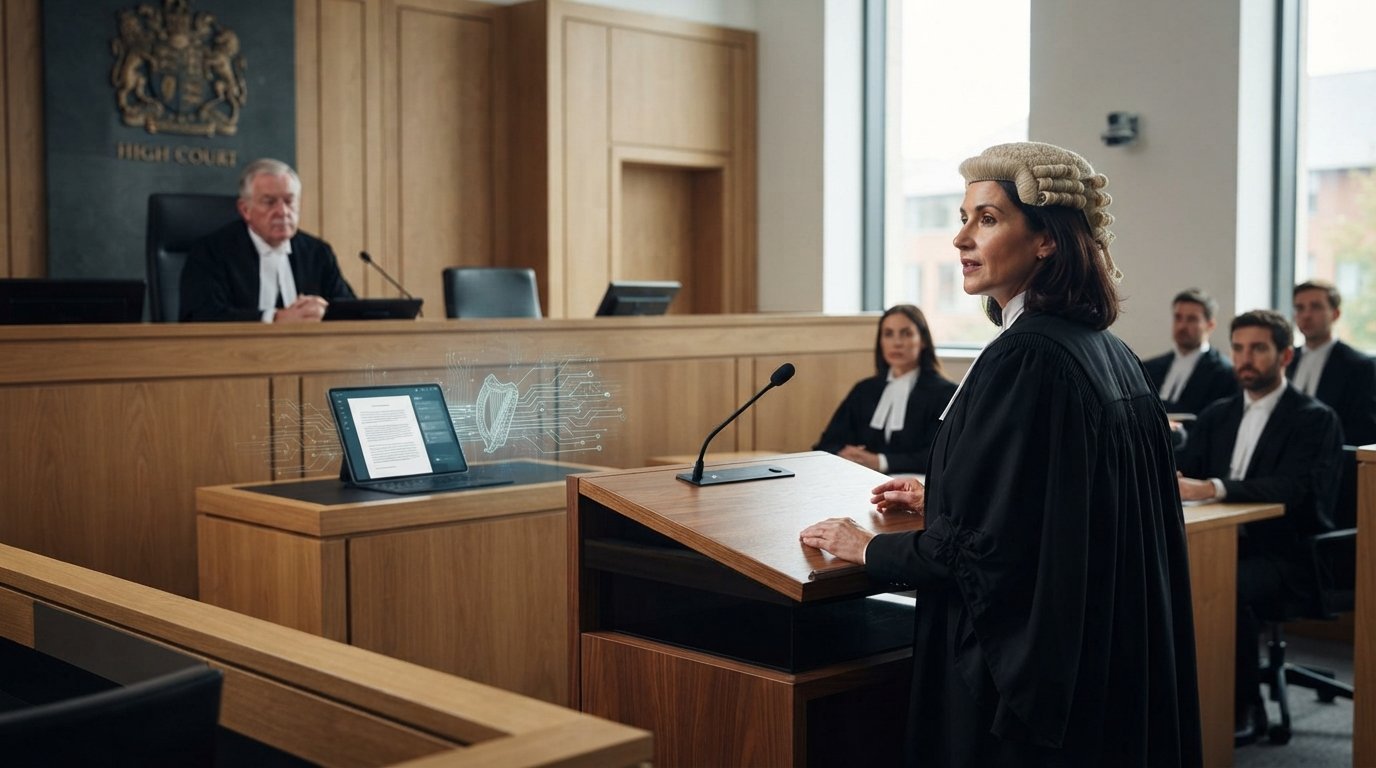
High Court Sets New AI Rules for Irish Proceedings
Irish High Court Lays Groundwork for Accountable AI Use in Business Operations
In a significant development for businesses leveraging artificial intelligence, the Irish High Court has unveiled a new Practice Direction (HC142) on the use of AI in Irish civil proceedings, set to take effect on 1 September 2026. While not a government-wide ethics framework, this directive establishes a robust set of guidelines directly impacting how Irish businesses deploy AI agents, reinforcing the critical need for accountability, rigorous verification, and clear disclosure in any official or regulated context.
This forward-looking move by the High Court signals a clear intention to ensure the integrity of information submitted to legal proceedings, placing the onus firmly on human users for any AI-generated content. For ai agents for small business automation and solo entrepreneurs across Ireland, understanding and preparing for these rules is paramount.
Understanding the High Court's New Practice Direction (HC142)
The new Practice Direction (HC142), which applies to all civil proceedings before the High Court, including existing cases from its effective date, outlines several key responsibilities:
- Human Accountability Remains Paramount: The court explicitly states that “Parties, legal practitioners, witnesses and experts remain fully responsible for the accuracy and integrity of any material submitted to the High Court.” This means that while ai automation tools ireland can streamline processes, the ultimate legal responsibility for their output rests with the user.
- Mandatory Independent Verification: Any content generated with the assistance of AI must be independently verified against authoritative sources. Crucially, the directive specifies, “Verifying AI-generated content using another AI tool is not sufficient.” This underscores the need for human oversight and critical assessment of AI outputs.
- Disclosure in Witness Statements and Affidavits: Generally, witness statements and affidavits will require a specific declaration confirming that generative AI was not used to create the substantive content.
- Expert Disclosure: Experts are now required to disclose their use of AI where relevant, enabling the court to assess the reliability and independence of their findings.
- Consequences of Non-Compliance: Failure to adhere to these rules can lead to serious repercussions, including adverse costs, rejection of documents, the strike-out of claims or defences, and even referral of legal practitioners to regulatory bodies.
What This Means for Irish SMEs Deploying AI Agents
For ai tools for irish entrepreneurs and businesses of all sizes, these guidelines have significant implications, particularly as the use of ai agent software for business owners becomes more widespread. The core takeaway is a heightened duty of care when integrating AI into workflows:
- Rigorous Review of Outputs: Small and medium-sized enterprises (SMEs) using ai agents for customer support small business, ai agents for admin tasks small business, or internal workflows must assume a strong duty to meticulously review AI-generated outputs before they are used in any regulated, official, or public-facing context. This includes marketing materials, financial reports, or communications that could eventually become part of legal proceedings.
- Transparency Under the EU AI Act: Beyond the High Court's directive, Irish businesses deploying AI agents that interact with users in the EU may also face Article 50 transparency obligations under the broader EU AI Act framework. This typically includes a clear disclosure that the user is interacting with an AI system, rather than a human. It's important to note that small business size does not exempt companies from these disclosure duties for AI-facing systems.
- Personal Use Accountability: Even for a personal ai assistant ireland or ai assistant for managing emails and calendar, the practical advice is to avoid relying solely on AI for decisions or submissions where accuracy, accountability, or traceability are critical. The Irish rules consistently place ultimate responsibility on the human user.
This regulatory landscape reinforces the need for ai workflow automation for small business solutions that are not only efficient but also built with accountability and verification in mind. Whether it's ai agents for content creation for small business or ai agents for lead generation, the human element of oversight is irreplaceable.
Navigating the Future of AI with Confidence
The High Court's Practice Direction, while specific to legal proceedings, sets a precedent for responsible AI deployment across the board. It highlights the importance of choosing best ai agents for small businesses that are designed to support human oversight and facilitate verification, rather than replace it entirely.
Irish businesses now have an even stronger incentive to implement robust processes for reviewing AI-generated content. Companies like AISolutionsIreland, which specialise in custom ai assistant for small business ireland and affordable ai workflow automation ireland, are uniquely positioned to help. Our solutions, from privacy-first document-trained customer support chatbots to our OpenClaw managed implementation service that provides private, secure, and fully-owned AI agents, are designed with accountability and seamless integration into existing workflows in mind. We understand the local landscape and offer personalized support to ensure your AI agents are not only effective but also compliant with evolving Irish and EU regulations, offering a clear alternative to the typical ai agent subscription ireland model with our one-time setup fee and pay-as-you-go usage.
As the 1 September 2026 deadline approaches, businesses have an opportunity to proactively adapt their AI strategies. Embracing solutions that champion transparency, verification, and human oversight will be key to unlocking the full potential of AI while navigating the new era of accountability.