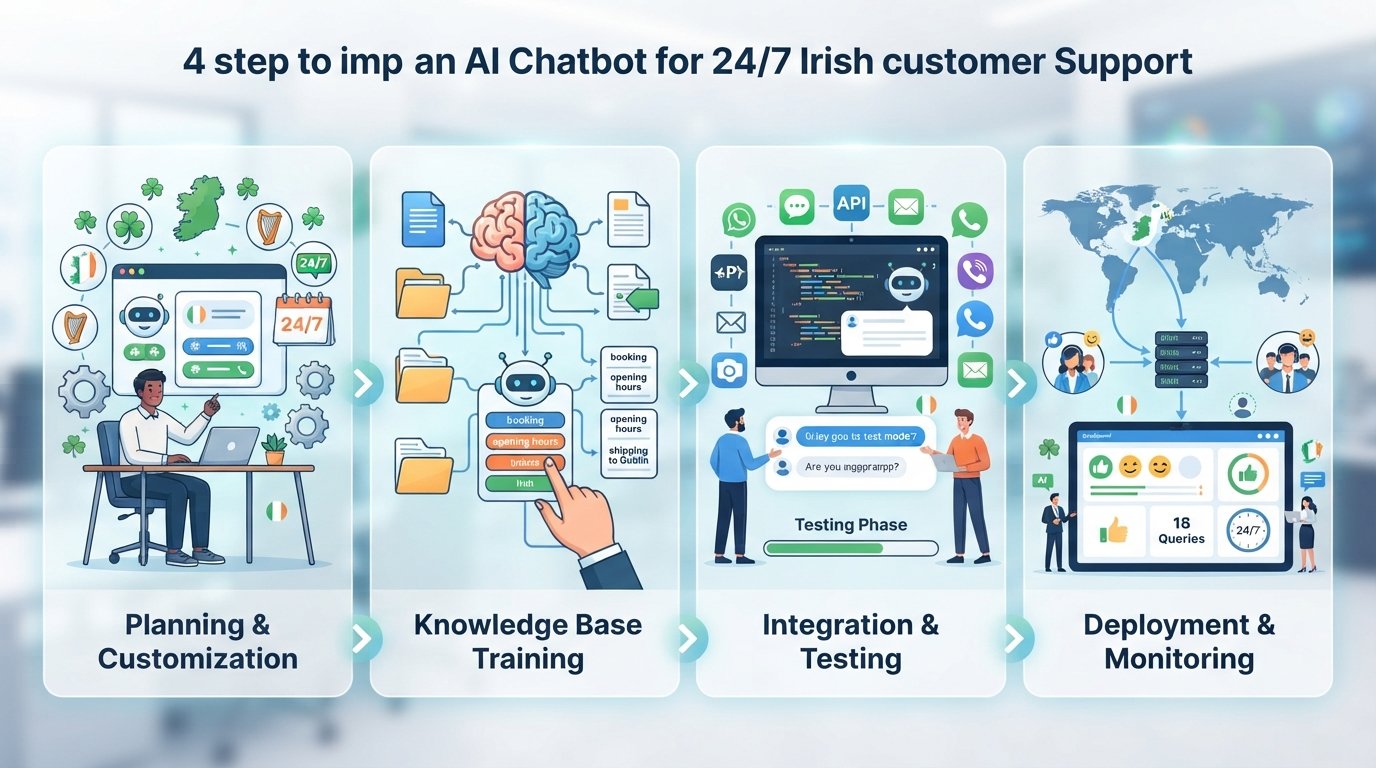
Implement an AI Chatbot for 24/7 Irish Customer Support
How to Implement an AI Chatbot for 24/7 Customer Support in Your Irish Business
In today’s fast-paced digital landscape, customer expectations for instant support are higher than ever. For Irish businesses, both small and large, meeting these demands around the clock can be a significant challenge, often stretching resources thin. This comprehensive guide will walk you through the process of implementing an AI chatbot to provide efficient, 24/7 customer support, ensuring your customers always feel heard and valued. You'll learn how to choose the right solution, prepare your data, design intelligent conversations, and seamlessly integrate your new AI agent into your existing operations.
By harnessing the power of AI agents for business process automation, you can transform your customer service, reduce operational costs, and free up your human team to focus on more complex, high-value interactions. This isn't just about automation; it's about elevating your customer experience, boosting your business's competitiveness, and ensuring you're available to your Irish customers whenever they need you, day or night. Let's explore how AISolutionsIreland can help your business thrive with smart, locally-designed AI solutions.
Who This Is For
- Irish small and medium-sized enterprises (SMEs) looking to improve customer service.
- Businesses experiencing high volumes of routine customer inquiries.
- Companies aiming to provide 24/7 support without increasing headcount.
- Entrepreneurs and solo entrepreneurs seeking to automate customer interactions.
- Organisations wanting to free up their customer support teams for complex tasks.
Step 1: Define Your Customer Support Needs and Goals
Before diving into technology, it's crucial to understand what you aim to achieve with an AI chatbot. A clear definition of your customer support challenges and desired outcomes will guide your implementation strategy, ensuring you select and configure a solution that truly adds value to your Irish business. This foundational step involves analysing your current support operations, identifying pain points, and setting measurable objectives.
Consider the types of queries your customers frequently ask, the channels they use for support (website, social media, phone), and the peak times for inquiries. Are common questions overwhelming your human agents? Do customers complain about slow response times outside of business hours? Understanding these aspects will help you scope the chatbot's role effectively and ensure it integrates seamlessly into your overall customer experience strategy.
- Analyse Current Customer Queries: Review your support tickets, emails, and call logs to identify the most common questions and issues. Categorise them by topic (e.g., product information, order status, FAQs, technical support). This data is invaluable for training your AI agent.
- Identify Pain Points and Gaps: Pinpoint areas where your current customer support falls short. This could include long wait times, limited operating hours, inconsistent answers, or high agent turnover.
- Set Clear, Measurable Goals: Define what success looks like. Examples include:
- Reduce call volume by 30% for routine inquiries.
- Improve first-response time to under 1 minute.
- Increase customer satisfaction (CSAT) scores by 10%.
- Provide 24/7 support availability for basic queries.
- Decrease agent workload by automating 50% of repetitive tasks.
- Determine the Chatbot's Scope: Decide which types of queries the chatbot will handle initially. Start with a narrow scope (e.g., FAQs, basic product info, business hours) and expand its capabilities over time as it learns and improves.
- Outline Escalation Paths: For complex issues that the chatbot cannot resolve, define a clear process for seamlessly handing off the customer to a human agent, specifying when and how this transfer should occur.
Tip: Don't try to make your chatbot solve every problem from day one. Start with a defined set of common, repetitive tasks where it can provide immediate value. This ensures a smoother rollout and quicker ROI for your Irish business.
Step 2: Choose the Right AI Chatbot Solution for Your Irish Business
With your needs and goals clearly defined, the next critical step is selecting the AI chatbot solution that best fits your business. This decision is multifaceted, involving considerations of customisation, integration capabilities, compliance, and ongoing support. For Irish businesses, ensuring GDPR and EU AI Act compliance is paramount, making local expertise and privacy-first solutions a significant advantage.
You'll encounter various options, from off-the-shelf SaaS platforms to custom-built AI agents. Each has its pros and cons regarding flexibility, cost, and implementation time. Evaluating these factors carefully will ensure you invest in a solution that provides the best long-term value and aligns with your strategic vision for AI tools for Irish small business owners.
- Evaluate Custom vs. Off-the-Shelf Solutions:
- Off-the-Shelf: Faster setup, lower initial cost, but less customisation and might not fit unique Irish business workflows perfectly. Good for basic FAQs.
- Custom AI Agents: Tailored to your specific needs, integrates deeply with existing systems, offers greater control over data and functionality. Ideal for complex workflows and unique brand voices. This is where AISolutionsIreland excels, offering solutions designed around how businesses actually work.
- Consider Key Features: Look for features essential for your defined goals, such as:
- Natural Language Processing (NLP) capabilities for understanding complex queries.
- Multi-language support (important for diverse customer bases in Ireland).
- Integration capabilities with CRM, helpdesk, and e-commerce platforms.
- Analytics and reporting dashboard for monitoring performance.
- Easy-to-use interface for content updates and conversation flow management.
- Scalability to grow with your business needs.
- Prioritise Data Privacy and Security: Given GDPR and the evolving EU AI Act, ensure your chosen provider offers robust data protection, secure data handling, and transparent privacy policies. AISolutionsIreland's OpenClaw service provides private, secure, and fully-owned AI agents on a VPS with zero-trust VPN, ensuring your data remains within your control.
- Assess Implementation and Support: Inquire about the setup process, deployment timelines, and ongoing support. For Irish businesses, local support can be invaluable for smooth integration and quick problem resolution. AISolutionsIreland offers fast setup (days, not weeks) and personal support.
- Understand the Pricing Model: Compare one-time setup fees, monthly subscriptions, and usage-based costs. Services like OpenClaw offer a one-time setup fee (€199) plus pay-as-you-go usage, which can be more cost-effective than recurring subscriptions for many Irish SMEs.
Warning: Be wary of "one-size-fits-all" solutions that promise quick fixes without understanding your unique business context. A chatbot that doesn't align with your specific customer service workflow can lead to frustration for both your customers and your team. Investing in custom AI agents can provide a significant strategic advantage.
Step 3: Gather and Prepare Your Knowledge Base Data
The intelligence of your AI chatbot is directly proportional to the quality and breadth of the data it's trained on. This step is arguably the most critical for ensuring your chatbot can provide accurate, helpful, and consistent answers. For a document-trained customer support chatbot, compiling a comprehensive, well-organised knowledge base is non-negotiable.
Think of your knowledge base as the chatbot's brain. It needs to be populated with all the information your customer support agents use daily, presented in a structured and easily digestible format. This process requires a thorough audit of your existing documentation and, in many cases, the creation of new content specifically optimised for AI consumption.
- Audit Existing Documentation: Collect all relevant customer-facing information, including:
- Frequently Asked Questions (FAQs)
- Product/service descriptions and specifications
- Company policies (returns, shipping, privacy, terms of service)
- Troubleshooting guides
- How-to articles and tutorials
- Contact information and business hours
- Marketing materials with key product benefits
- Standardise and Organise Data: Ensure information is consistent, up-to-date, and presented in a clear, unambiguous language. Remove jargon and conflicting information. Organise documents into logical categories and use consistent formatting.
- Create New Content as Needed: Identify any gaps in your knowledge base that your chatbot will need to address. For instance, if your customers frequently ask about local delivery options in Ireland, ensure this information is clearly documented.
- Format Data for AI Consumption: While advanced AI platforms can process various formats, structuring your data, ideally in text-based documents (PDFs, Word docs, web pages), will significantly improve training accuracy. Break down long documents into smaller, digestible chunks covering specific topics.
- Clean and Refine Data: Remove irrelevant or outdated information. Correct any grammatical errors or typos. High-quality input leads to high-quality output from your AI agent.
- Consider Data for Specific Personas: If your business serves different customer segments, consider how to tailor responses based on those needs. For example, a B2B customer might need different information than a B2C customer.
Tip: Involve your human customer support team in this step. They are on the front lines and have invaluable insights into what customers ask and how they phrase their questions. Their input will make your knowledge base much more effective for training your AI chatbot.
Step 4: Design Your Chatbot's Personality and Conversation Flow
A successful AI chatbot doesn't just answer questions; it engages users in a natural, helpful, and on-brand manner. Designing your chatbot's personality and mapping out its conversation flows are crucial for creating a positive user experience and ensuring it reflects your Irish business's unique voice and values. This moves beyond pure functionality to the art of interaction.
Consider your brand's existing tone—is it formal, friendly, witty, or professional? Your chatbot should emulate this to provide a consistent brand experience. Furthermore, anticipating user questions and planning the logical progression of conversations will prevent frustration and guide customers efficiently to their desired outcome, whether that's an answer, a resolution, or an escalation to a human agent.
- Define Your Chatbot's Persona:
- Name: Give your chatbot a unique, memorable name.
- Tone of Voice: Should it be friendly, professional, empathetic, or concise? Align this with your brand identity.
- Language: Ensure it uses clear, natural language relevant to your Irish audience, avoiding overly technical jargon where possible.
- Limitations: Be transparent about what the chatbot can and cannot do to manage user expectations.
- Map Out Conversation Flows: For each common query or task, design the step-by-step interaction. This typically involves:
- Initial Greeting: How does the chatbot introduce itself and its capabilities?
- Query Clarification: If the user's intent is unclear, how does the chatbot ask clarifying questions?
- Information Delivery: How is the answer presented? Is it a short text, a link, or a list?
- Follow-up Questions: What does the chatbot ask after providing an answer? ("Did that help?", "Is there anything else I can assist with?").
- Error Handling: What happens when the chatbot doesn't understand a query? How does it guide the user or offer alternatives?
- Escalation Path: Clearly define when and how a conversation is handed off to a human agent, providing context to the agent.
- Craft Engaging Responses: Write clear, concise, and helpful responses. Use emojis, rich media (images, videos), and quick replies where appropriate to enhance the user experience.
- Integrate Human Handoffs Seamlessly: Ensure the transition from chatbot to human is smooth, with the human agent receiving the full transcript of the conversation to avoid repetition for the customer. This is key for effective AI workflow tools for small teams Ireland.
- Anticipate User Intent and Variations: Think about the different ways users might phrase the same question. For example, "How do I return a product?" could also be "Can I send something back?", "What's your refund policy?", or "I need to make a return."
Warning: Avoid making your chatbot overly verbose or trying to mimic human conversation too perfectly. Authenticity in its "bot-ness," combined with clear functionality and a helpful persona, often leads to a better user experience than a bot trying too hard to seem human and failing.
Step 5: Train and Test Your AI Chatbot Rigorously
Once your knowledge base is prepared and conversation flows are designed, the next crucial phase is training and extensive testing of your AI chatbot. This iterative process ensures that your bot accurately understands user intent, provides correct information, and delivers a smooth user experience. Without thorough testing, you risk deploying a chatbot that frustrates customers rather than helps them.
Training an AI agent is an ongoing process. Initial training involves feeding it your prepared data. However, real-world interactions will reveal nuances and gaps that require continuous refinement. This step is where your AI agent truly learns to become a valuable asset for your Irish business, capable of handling complex interactions and providing nuanced support.
- Initial Training: Load your prepared knowledge base data into the chatbot platform. The AI will process this information to understand relationships between concepts and generate appropriate responses. For custom AI agents, this involves setting up and configuring the large language models (LLMs) or neural networks with your proprietary data.
- Simulated User Testing: Have internal teams, particularly those who interact with customers, test the chatbot extensively. Provide them with a list of common questions and scenarios, and ask them to interact with the bot as a real customer would.
- Test both common and edge-case questions.
- Vary wording and phrasing for the same question.
- Test escalation paths to human agents.
- Verify the accuracy and completeness of responses.
- Check for consistent tone and brand voice.
- Identify and Address Gaps/Errors: During testing, log any instances where the chatbot provides incorrect information, fails to understand a query, or gets stuck in a loop. Use this feedback to:
- Refine your knowledge base content.
- Adjust conversation flows.
- Add more training data for misunderstood intents.
- Improve the chatbot's ability to handle variations in user input.
- Pilot Launch with a Small User Group: Before a full public launch, consider a phased rollout to a small group of trusted customers or internal employees outside the development team. Gather their feedback directly to identify any unforeseen issues in a live environment.
- Continuous Iteration: AI chatbots are not "set it and forget it" solutions. Plan for ongoing monitoring and refinement. As new products launch, policies change, or new customer issues emerge, your chatbot's knowledge base and training will need to be updated.
Tip: Encourage your testers to "break" the chatbot. The more challenging and varied the test scenarios, the more robust and intelligent your AI agent will become. This proactive approach helps to ensure your buy AI agent software for business is truly effective.
Step 6: Integrate Your Chatbot with Existing Systems
For your AI chatbot to deliver maximum value, it must operate seamlessly within your existing technology ecosystem. Integration with crucial business systems like CRM, helpdesk software, and e-commerce platforms allows the chatbot to access and update customer information, process orders, and provide personalised support. This connectivity transforms your chatbot from a simple Q&A tool into a powerful AI workflow automation for small businesses in Ireland.
Effective integration reduces manual data entry, prevents information silos, and ensures a consistent customer experience across all touchpoints. It enables your chatbot to perform actions like checking order status, updating customer profiles, or even initiating returns, significantly expanding its utility beyond just answering questions. This step is vital for any Irish entrepreneur looking to truly leverage AI agents for business process automation.
- CRM Integration: Connect your chatbot to your Customer Relationship Management (CRM) system (e.g., Salesforce, HubSpot). This allows the chatbot to:
- Access customer historical data for personalised interactions.
- Log chatbot conversations as part of the customer record.
- Update customer information based on chatbot interactions (e.g., change of address).
- Helpdesk/Ticketing System Integration: Link your chatbot with your helpdesk software (e.g., Zendesk, Freshdesk). This is crucial for:
- Seamlessly escalating complex queries to human agents with full conversation context.
- Creating new support tickets automatically when the chatbot cannot resolve an issue.
- Reducing duplicate inquiries by checking existing tickets.
- E-commerce Platform Integration: If you run an online shop, integrate your chatbot with your e-commerce platform (e.g., Shopify, WooCommerce). This enables it to:
- Provide real-time order status updates.
- Process simple returns or cancellations.
- Offer product recommendations.
- Assist with shopping cart queries.
- Internal Knowledge Base/Database Integration: While your initial training data comes from documents, direct integration with a dynamic internal knowledge base ensures the chatbot always has access to the most current information, especially if it changes frequently.
- Website/App Embedding: Deploy your chatbot on your website or within your mobile app. Ensure it's easily accessible but not intrusive, typically via a chat widget in the corner of the screen.
- API Connections: Leverage APIs (Application Programming Interfaces) to create custom integrations between your chatbot and other proprietary systems or third-party tools specific to your Irish business. AISolutionsIreland specializes in custom AI workflow development that integrates seamlessly.
Tip: Prioritise integrations based on their impact on your core business processes and customer journey. Start with the most critical integrations and expand as your chatbot's capabilities grow. For specific guidance, see our FAQs on AI Agent Integration with Irish Business Software.
Step 7: Launch, Monitor, and Optimise Your 24/7 Support Agent
With thorough preparation, training, and integration, your AI chatbot is ready for its public debut. However, launching is not the end; it's the beginning of an ongoing process of monitoring, analysis, and optimisation. The true power of an AI agent lies in its ability to learn and improve over time, making this continuous feedback loop essential for its long-term success as a 24/7 customer support solution for your Irish business.
Regularly reviewing your chatbot's performance metrics and user feedback will allow you to identify areas for improvement, expand its capabilities, and ensure it continues to meet your evolving customer service needs. This iterative approach is how you transform a functional chatbot into an indispensable asset that provides genuine value to both your customers and your bottom line.
- Phased Rollout: Consider a soft launch initially, perhaps on a specific section of your website or during off-peak hours, to gradually expose the chatbot to real users and gather initial live feedback without overwhelming your system.
- Announce and Educate: Inform your customers about the new AI chatbot. Explain its purpose, what it can do, and how it can help them. Manage expectations by clearly stating its capabilities and how to reach a human if needed.
- Monitor Key Performance Indicators (KPIs): Regularly track the metrics you defined in Step 1. Key KPIs include:
- Resolution Rate: Percentage of issues the chatbot resolves without human intervention.
- Escalation Rate: How often queries are handed off to human agents.
- Customer Satisfaction (CSAT): Gathered through post-chat surveys.
- Conversation Volume: Number of interactions the chatbot handles.
- Average Handle Time: How long it takes the chatbot to resolve an issue.
- Missed Intent Rate: How often the chatbot fails to understand user queries.
- Analyse Chat Transcripts: Periodically review actual chat conversations. This qualitative data is invaluable for understanding how users interact with your bot, identifying common points of confusion, and discovering new topics your bot needs to learn.
- Collect User Feedback: Implement short, post-chat surveys to directly ask users about their experience with the chatbot. Pay attention to comments about accuracy, helpfulness, and ease of use.
- Refine and Update: Based on your monitoring and feedback:
- Update your knowledge base with new information or improved explanations.
- Add new intents or expand the chatbot's understanding of existing ones.
- Tweak conversation flows to be more intuitive.
- Address any technical glitches or integration issues.
- Expand Capabilities: As the chatbot becomes proficient in its initial scope, gradually introduce new features or expand its ability to handle more complex tasks, continually improving its value as an AI agent for Irish SMEs.
Warning: Never stop monitoring. Customer needs and business information evolve. A stagnant chatbot will quickly become outdated and ineffective, undermining the investment your Irish business has made in this powerful technology.
Common Mistakes to Avoid When Implementing an AI Chatbot
Implementing an AI chatbot for 24/7 customer support can significantly benefit your Irish business, but certain pitfalls can hinder its effectiveness. Being aware of these common mistakes allows you to navigate the implementation process more smoothly and ensure your AI agent delivers real value.
- Lack of Clear Objectives: Without well-defined goals (Step 1), your chatbot project can lack direction, leading to a tool that doesn't effectively solve any specific problems. Ensure you know exactly what you want your chatbot to achieve before you begin.
- Insufficient Data Preparation: A chatbot is only as good as the data it's trained on. Rushing Step 3, or using incomplete, inconsistent, or outdated information, will result in a chatbot that provides inaccurate or unhelpful responses, frustrating your customers.
- Neglecting Chatbot Personality and Tone: A robotic, impersonal chatbot can alienate users. Failing to define a persona and conversational style (Step 4) that aligns with your brand can lead to a disjointed customer experience and negatively impact brand perception.
- Skipping Thorough Testing: Deploying a chatbot without rigorous internal and pilot testing (Step 5) is a recipe for disaster. Unforeseen bugs, misunderstandings, or broken flows will quickly surface in live interactions, damaging customer trust.
- Ignoring Seamless Human Handoffs: While chatbots automate, they cannot solve everything. A poorly designed escalation path to a human agent can leave customers feeling abandoned or forced to repeat themselves, negating the benefits of automation.
- Overpromising Capabilities: Setting unrealistic expectations for your chatbot's abilities can lead to user frustration. Be transparent about its limitations and ensure customers know when and how to reach a human.
- Lack of Ongoing Monitoring and Optimisation: A chatbot is not a "set it and forget it" solution. Failing to continuously monitor performance, analyse interactions, and update its knowledge base and flows (Step 7) will lead to an outdated and ineffective tool over time.
- Failing to Integrate with Existing Systems: A standalone chatbot misses out on critical functionality. Not integrating with your CRM, helpdesk, or other business tools (Step 6) limits its ability to provide personalised, action-oriented support and can create data silos.
- Over-reliance on Generic Solutions: While off-the-shelf chatbots are easy to deploy, they might not cater to the specific nuances and local context of your Irish business. Generic solutions can lack the depth of customisation needed for truly effective AI agents for content creation for small business or complex support queries.
FAQ
What is the typical timeline for implementing an AI chatbot for an Irish business?
The timeline can vary significantly depending on the complexity of your needs and the type of solution chosen. For a custom, document-trained AI chatbot handling specific functions, initial setup can be remarkably fast—AISolutionsIreland, for instance, can often have an AI agent launch-ready in 24–48 hours for its OpenClaw service, with full integration and comprehensive training taking a few days to a few weeks. More extensive integrations or highly complex conversation flows will naturally extend this period, but generally, expect to see your first functional chatbot deployed within weeks rather than months.
How does an AI chatbot ensure GDPR compliance for Irish businesses?
Ensuring GDPR compliance is a critical consideration for any AI solution in Ireland. A reputable AI chatbot provider will design their systems with privacy by design. Key aspects include:
- Data Minimisation: Only collecting necessary customer data.
- Data Encryption: Protecting all data in transit and at rest.
- Consent Mechanisms: Clearly informing users about data collection and obtaining consent.
- Data Anonymisation: Where possible, processing data in an anonymised form.
- Local Hosting: Solutions like AISolutionsIreland's OpenClaw, hosted on a private VPS in the EU, ensure data residency within GDPR jurisdiction, offering greater control and compliance peace of mind.
- Audit Trails: Maintaining logs of data access and processing.
What is the return on investment (ROI) for implementing a 24/7 AI chatbot in an Irish SME?
The ROI for a 24/7 AI chatbot can be substantial for Irish SMEs. While specific figures vary, common benefits include:
- Reduced Operational Costs: By automating routine queries, you decrease the need for a large human support team, saving on staffing and training expenses.
- Increased Customer Satisfaction: 24/7 availability and instant responses lead to happier customers and improved retention.
- Improved Agent Productivity: Human agents are freed from repetitive tasks to focus on complex, high-value interactions.
- Higher Sales Conversion: Chatbots can guide customers through purchasing decisions, answer product questions instantly, and even process orders, potentially boosting sales.
- Data Collection for Business Insights: Chatbot interactions provide valuable data on customer needs, pain points, and product interest, which can inform business strategy.
Can an AI chatbot handle complex customer service issues or just simple FAQs?
Modern AI chatbots, especially custom-built AI agents, are capable of much more than just simple FAQs. While they excel at handling repetitive questions quickly and accurately, their capabilities extend to:
- Transactional Tasks: Processing orders, managing bookings, initiating returns, or updating account details (with appropriate system integrations).
- Personalised Interactions: Accessing CRM data to provide tailored recommendations or support based on customer history.
- Lead Qualification: Engaging with potential customers, asking qualifying questions, and routing them to the appropriate sales team.
- Multilingual Support: Interacting with customers in various languages, broadening your reach.
- Proactive Engagement: Initiating conversations based on user behaviour on your website.
Next Steps
Ready to transform your customer support with an intelligent AI chatbot designed for your Irish business? Explore our comprehensive range of AI solutions, including our privacy-first OpenClaw service, and discover how AISolutionsIreland can help you implement personalised AI agents for Irish SMEs that truly work the way you do.