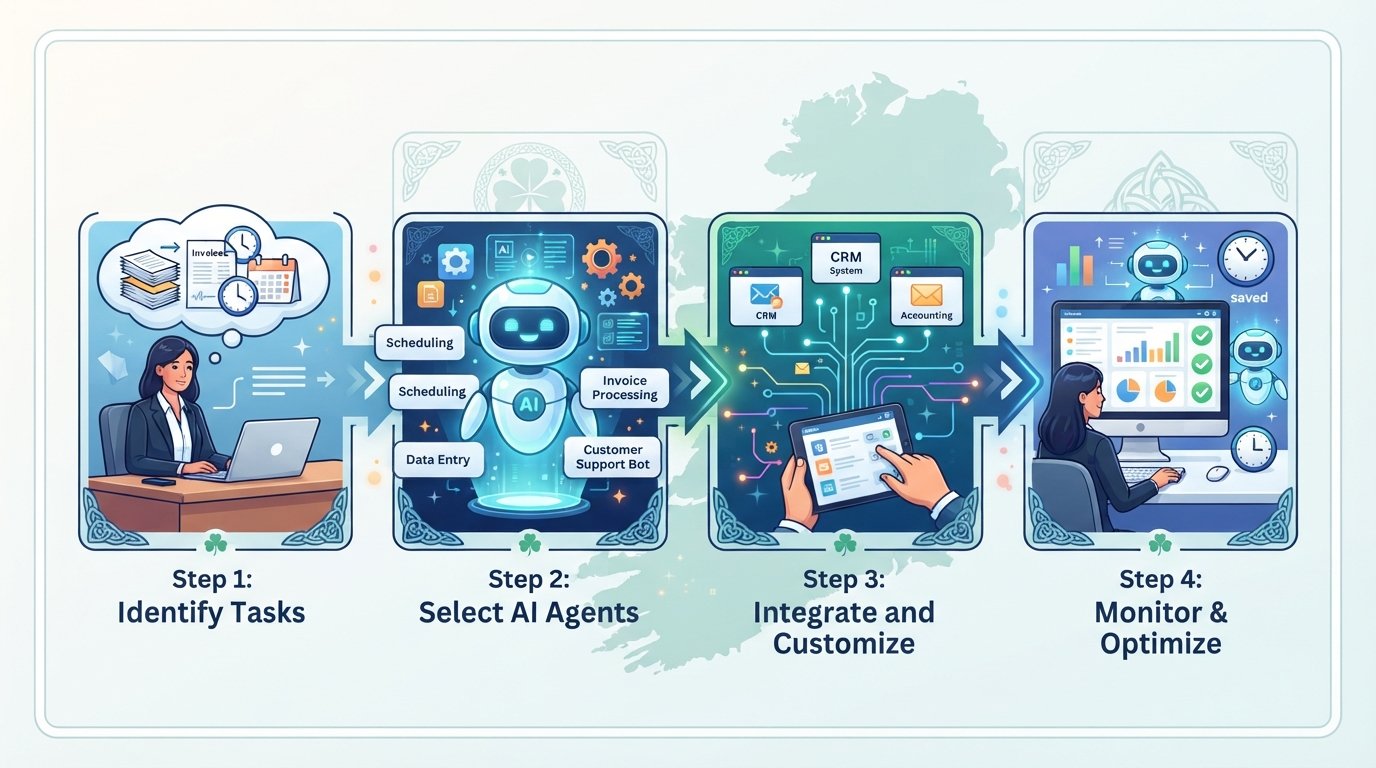
How to Automate Tedious Admin Tasks for Your Irish Business with AI Agents
Introduction: Reclaiming Your Time with AI Automation in Ireland
For many Irish businesses, particularly small and medium-sized enterprises (SMEs) and solo entrepreneurs, the daily grind of administrative tasks can feel like an endless cycle. From managing emails and scheduling appointments to processing invoices and updating databases, these essential but often repetitive duties consume valuable time and resources. This time could be far better spent on strategic growth, customer engagement, or innovating your core services. Imagine a world where these mundane tasks simply happen, without your direct intervention, freeing you to focus on what truly matters.
This is precisely where AI agents come into play. Artificial Intelligence (AI) agents are intelligent software programs designed to perform specific tasks autonomously, learning and adapting over time. For Irish businesses, leveraging these powerful tools can be a game-changer, transforming operational efficiency and boosting productivity. This comprehensive guide will walk you through the practical steps to identify, implement, and optimise AI automation for the most tedious administrative tasks within your Irish business. We'll explore how these intelligent assistants can act as your personal digital workforce, offering significant advantages whether you're an `ai automation for irish home businesses`, an `ai agents for solo entrepreneurs`, or a growing SME looking for the `best ai automation for irish companies`. By the end, you'll understand why embracing `ai automation tools ireland` is not just a luxury, but a strategic necessity for sustainable growth.
Who This Is For
- Irish Small Business Owners & Managers overwhelmed by daily admin.
- Solo Entrepreneurs & Freelancers seeking to maximise personal productivity.
- Office Managers looking to streamline departmental workflows.
- Professionals in any field burdened by repetitive, time-consuming tasks.
- Anyone interested in leveraging `custom ai agents for small business` to reclaim their valuable time.
Step 1: Identify Your Most Tedious Admin Tasks
The first and most crucial step in implementing AI automation is understanding what needs to be automated. It's easy to feel overwhelmed by the sheer volume of administrative work, but not every task is an ideal candidate for AI. The key is to pinpoint those tasks that are repetitive, rule-based, time-consuming, and offer a clear benefit when automated. Think about the duties that consistently pull you away from higher-value work or that you dread doing.
Begin by meticulously documenting your daily and weekly administrative routines. Don't underestimate the small tasks; even those that take only a few minutes can add up significantly over a month. Once you have a comprehensive list, categorise these tasks by frequency, time spent, and the level of cognitive effort they require. Prioritise tasks that are highly repetitive, involve structured data, and follow a predictable set of rules. These are the low-hanging fruit for AI automation, capable of delivering immediate impact for `ai automation for irish home businesses` and `ai agents for solo entrepreneurs` looking for quick wins.
- List All Daily/Weekly Admin Tasks: From checking emails and managing calendars to data entry, report generation, and invoice tracking, document every single administrative duty you or your team performs regularly.
- Quantify Time Spent: For each task, estimate or track the average amount of time it consumes per day or week. Be honest; even 15 minutes here and there can quickly accumulate.
- Identify Repetitive & Rule-Based Tasks: Look for tasks that involve the same steps repeatedly, with minimal variation. Examples include moving data between spreadsheets, sending standard follow-up emails, or categorising customer queries.
- Assess Task Complexity: Does the task require human judgment, creativity, or complex problem-solving? If not, it's a strong candidate for AI automation. If it does, consider if specific parts of the task can still be automated.
- Pinpoint Bottlenecks: Which admin tasks often hold up other processes or cause delays in your workflow? Automating these can have a ripple effect, improving overall efficiency.
- Consider Error Prone Tasks: Humans are prone to errors, especially during repetitive tasks. Tasks where small mistakes can have significant consequences are excellent candidates for automation.
Tip: Engage your team in this process. They are on the front lines of administrative work and can offer invaluable insights into what tasks are most burdensome and suitable for automation.
Step 2: Define the Scope and Goals for AI Automation
With a clear understanding of the tasks you want to automate, the next step is to define precise goals and scope for each. Automation for automation's sake can lead to wasted effort and resources. Instead, approach each potential automation with a clear vision of what you want to achieve. This strategic thinking ensures that your `ai automation tools ireland` deliver tangible benefits and contribute directly to your business objectives.
For each selected task, ask yourself: What specific problem am I trying to solve? How will I measure the success of this automation? Defining measurable Key Performance Indicators (KPIs) is essential. For instance, if you're automating email sorting, a goal might be to reduce manual sorting time by 80% or to ensure 95% of incoming emails are correctly categorised. This step helps in setting realistic expectations and provides a benchmark for evaluating the effectiveness of your `ai agent software for business owners`. It also forces you to think about the data inputs and outputs required, laying the groundwork for the design phase.
- Outline Desired Outcomes: For each identified task, clearly articulate what you want the AI agent to achieve. For example, "Automate appointment scheduling to reduce manual booking time by 50%" or "Automate invoice processing to reduce errors by 75%."
- Set Measurable KPIs: Establish specific, quantifiable metrics to track the success of your automation. This could include time saved, error reduction rates, processing speed, or employee satisfaction.
- Identify Data Inputs & Outputs: Determine what information the AI agent will need to perform its task (inputs) and what information it will generate or update (outputs). For example, an email management agent needs access to your inbox (input) and will categorise emails or draft replies (output).
- Consider Integration Points: Think about where the AI agent will interact with your existing software and systems (CRM, accounting software, calendar, etc.). This helps to visualise the workflow.
- Start Small, Think Big: Choose one or two high-impact, low-complexity tasks to start with. Successfully automating these builds confidence and provides valuable learning before tackling more complex processes.
- Document Current Process: Create a simple flow chart or step-by-step document of how the task is currently performed. This will serve as a blueprint for the AI agent's logic.
Warning: Avoid vague goals like "make things more efficient." Be specific. Without clear, measurable objectives, it will be impossible to assess the true value of your AI investment.
Step 3: Choose the Right AI Agent Solution for Your Needs
Once you know what you want to automate and why, the next critical step is selecting the right `ai agent software for business owners` or service provider. The landscape of AI solutions is vast, ranging from off-the-shelf applications to highly customised platforms. For Irish businesses, finding a solution that understands local nuances and offers personalised support can make all the difference. This is where AISolutionsIreland excels, providing solutions designed specifically for how Irish businesses operate.
When considering your options, you'll generally find two main approaches: using pre-built AI tools or opting for `custom ai agents for small business`. While pre-built tools might offer a quicker entry point for very simple tasks, they often lack the flexibility and precision required for unique business workflows. Custom AI agents, on the other hand, are tailored to your exact needs, integrating seamlessly with your existing systems and adhering to specific operational rules. Solutions like our OpenClaw - Clawd Bot Managed Implementation Service offer private, secure, and fully-owned AI agents, avoiding the limitations and recurring subscriptions of many generic platforms. This ensures data privacy and gives you full control, which is a significant advantage for any Irish company navigating data protection regulations.
- Research AI Automation Platforms: Explore various tools available. Consider platforms known for specific types of automation (e.g., email management, data entry, customer support chatbots).
- Evaluate Off-the-Shelf vs. Custom Solutions:
- Off-the-Shelf: Pros - quicker to deploy, often subscription-based. Cons - limited customisation, may not fit unique Irish business workflows perfectly, potential data privacy concerns.
- Custom AI Agents: Pros - tailored to exact needs, seamless integration, full control over data, robust security and compliance (e.g., GDPR/EU AI Act). Cons - initial setup requires more detailed planning.
For a deeper dive into this comparison, see our guide on Custom AI Agents vs. Off-the-Shelf SaaS for Irish SMEs.
- Consider Privacy and GDPR Compliance: This is paramount for Irish businesses. Ensure the chosen solution or provider has strong data protection measures and complies with the EU AI Act and GDPR. Ask explicit questions about data storage, processing, and ownership.
- Assess Integration Capabilities: How easily can the AI agent connect with your existing CRM, ERP, accounting software, email platform, and calendar? Seamless integration is crucial to avoid creating new silos.
- Look for Scalability: Can the solution grow with your business? You might start with one automated task, but you'll likely want to expand later.
- Consult with AI Experts: Engage with specialists who can guide you through the options and help design the best solution. AISolutionsIreland offers local design and personal support, ensuring the solution fits your specific context.
- Review Cost Structure: Understand the pricing model. Some solutions have recurring subscriptions, while others, like our OpenClaw service, offer a one-time setup fee with pay-as-you-go usage, providing transparency and avoiding ongoing hidden costs. For insights into investment, check out Understanding the Costs of AI Agent Solutions for Irish SMEs.
Tip: When seeking the `best ai automation for irish companies`, prioritise providers who offer local support and have a proven track record of understanding the unique challenges and opportunities within the Irish market.
Step 4: Design and Train Your AI Agent
Once you've selected your AI solution or partner, the exciting part begins: designing and training your AI agent to perform its designated tasks. This step is a collaborative process, especially if you opt for `custom ai agents for small business`. It involves translating your defined goals and processes into actionable instructions that the AI can understand and execute. The quality of this design and training phase directly impacts the agent's effectiveness and accuracy, ensuring your `ai assistant for managing emails and calendar` or other administrative tasks performs flawlessly.
For custom solutions, you'll work closely with your provider (like AISolutionsIreland) to map out the agent's logic. This includes providing examples of inputs, specifying rules for decision-making, and defining the desired outputs. If you're building a simpler agent yourself, this involves configuring workflows, setting up triggers, and connecting APIs. Regardless of the approach, the goal is to "teach" the AI agent how to mimic and improve upon the human process it's replacing. This iterative process often involves initial training, testing, feedback, and further refinement until the agent reaches the desired level of performance and reliability.
- Provide Clear Instructions & Workflow Maps: Share the detailed process documentation from Step 2. The clearer your instructions, the better the AI agent will understand its role.
- Supply Relevant Data for Training:
- For document-based tasks (e.g., customer support, data extraction): Provide sample documents, FAQs, reports, and templates.
- For communication tasks (e.g., email management, chatbot): Provide historical emails, conversation logs, and desired response templates.
- For scheduling: Provide calendar access, meeting preferences, and availability rules.
The more quality data you provide, the smarter and more accurate your agent will become. This is crucial for building the `best ai agent software for personal use ireland` for specific tasks.
- Define Triggers and Actions: Clearly specify what events will prompt the AI agent to act (triggers) and what actions it should take in response.
- Example Trigger: New email received in the "Support" inbox.
- Example Action: Classify email, draft a response using a template, add to CRM, notify relevant team member.
- Set Up Decision Logic and Rules: For tasks requiring conditional actions, define the "if X, then Y" rules. This ensures the AI makes appropriate decisions without human oversight.
- Participate in Iterative Testing and Feedback: Be actively involved in testing the agent during its development. Provide detailed feedback on its performance, identify any errors or areas for improvement, and suggest adjustments to its logic or training data.
- Configure Integrations: Work with your provider to set up the necessary API connections or integrations with your other business software (e.g., linking your `ai assistant for managing emails and calendar` to Outlook or Google Calendar).
Warning: The principle of "garbage in, garbage out" applies strongly here. Poor quality or insufficient training data will lead to an underperforming AI agent. Invest time in preparing clean, relevant data.
For more details on this process, you can explore The Process of Designing and Implementing Custom AI Agents for Irish Businesses.
Step 5: Integrate and Pilot Your AI Agent
With your AI agent designed and initially trained, the next crucial phase is to integrate it into your operational environment and run a controlled pilot. This step allows you to test the agent's performance in a real-world setting without fully committing to a complete rollout. Proper integration ensures the AI agent can seamlessly interact with your existing systems, while a pilot program helps iron out any kinks and validate its effectiveness before widespread adoption.
Integration involves establishing the technical connections between your AI agent and the various software it needs to communicate with. This might include CRM systems, email platforms, accounting software, or project management tools. During the pilot phase, you'll deploy the AI agent to handle a limited scope of tasks or operate within a specific department. This allows for close monitoring, real-time feedback collection, and adjustments based on actual performance data, ensuring a smooth transition and reliable operation for your Irish business. This phased approach minimises disruption and builds confidence in the `ai agent software for business owners`.
- Connect to Existing Software:
- Email Platforms: Integrate the agent with your business email (Outlook, Gmail) for tasks like sorting, drafting, or scheduling. (Automate your day: AI Agents for Email & Calendar Management in Ireland)
- Calendar/Scheduling Tools: Connect for automated appointment booking and diary management. (AI Agents for Booking & Scheduling: A How-To Guide for Irish Businesses)
- CRM Systems: Integrate for automated lead qualification, data entry, or customer follow-ups.
- Accounting Software: Connect for invoice processing, expense tracking, or report generation.
- Project Management Tools: For automated task creation, updates, or notifications.
- Run a Pilot Program:
- Select a Limited Scope: Choose a small, manageable segment of the task or a specific team to test the AI agent.
- Define Success Metrics for Pilot: What are the key indicators that will tell you the pilot is successful? (e.g., specific time savings, accuracy rates, user satisfaction).
- Monitor Performance Closely: Track the AI agent's actions, outputs, and any errors in real-time.
- Gather User Feedback: Actively solicit input from employees interacting with the AI agent. Their practical experience is invaluable for identifying usability issues or areas for improvement.
- Document & Troubleshoot Issues: Keep a log of any problems encountered during the pilot. Work with your AI provider to diagnose and resolve these issues promptly.
- Provide User Training (if applicable): If the AI agent alters existing workflows for employees, provide clear training on how to interact with the new automated process.
Tip: Ensure your IT infrastructure can support the new integrations. A smooth technical rollout is as important as the agent's functional performance. To understand how quickly AI agents can integrate with Irish small businesses, refer to our FAQ on integration timelines.
Step 6: Monitor, Refine, and Scale Your AI Automation
Deploying an AI agent isn't a "set it and forget it" endeavour. For your AI automation to deliver sustained value to your Irish business, continuous monitoring, refinement, and strategic scaling are absolutely essential. The digital environment is constantly evolving, as are your business needs. An AI agent that isn't regularly reviewed and updated risks becoming inefficient or, worse, outdated.
This ongoing process ensures your AI agents remain accurate, perform optimally, and continue to meet your evolving business requirements. By actively monitoring performance, gathering feedback, and making iterative improvements, you can unlock the full potential of your `ai automation for irish personal use ireland` or business-wide solutions. As you see success in one area, you can then strategically scale these `ai tools for irish entrepreneurs` to other parts of your business, compounding the benefits of automation across your operations.
- Regularly Review Performance Metrics: Continuously track the KPIs established in Step 2. Are you achieving your desired time savings, error reductions, or increased throughput? Generate regular reports on the AI agent's activities.
- Collect Ongoing Feedback: Maintain open channels for user feedback. Employees who interact with the AI agent daily can offer critical insights into its performance and identify new opportunities or issues.
- Adjust Rules and Parameters: Based on performance data and feedback, be prepared to fine-tune the AI agent's logic, rules, or decision-making parameters. For example, you might need to add new keywords for email classification or adjust scheduling preferences.
- Retrain with New Data (if applicable): If your business processes or the type of data it handles changes, the AI agent may need to be retrained with updated information to maintain accuracy and relevance.
- Explore Opportunities for Further Automation: As you gain confidence and experience, look for adjacent or related tasks that could also benefit from AI automation, expanding your initial scope.
- Scale Successful Automations: Once an AI agent proves its value and stability in a pilot or limited deployment, plan its broader implementation across other departments or for a larger volume of tasks.
- Stay Informed on AI Advancements: The field of AI is rapidly evolving. Keep an eye on new features or models that could further enhance your existing AI agents or enable new automations.
Warning: Neglecting monitoring and refinement can lead to 'drift', where the AI agent's performance degrades over time due to changes in data, processes, or external factors. Treat your AI agents as living systems that require ongoing care.
Step 7: Ensure Security and Compliance
For any Irish business, deploying AI agents, especially those handling sensitive administrative tasks, brings crucial considerations around data security and regulatory compliance. With GDPR and the evolving EU AI Act, safeguarding personal and business data is not just good practice – it's a legal imperative. This step is about building trust, protecting your business, and ensuring your AI operations are fully compliant.
A robust security framework for your AI agents means understanding where your data is stored, how it's processed, and who has access to it. It also means actively choosing providers who prioritise privacy and compliance, such as those offering private, secure, and fully-owned AI agents on a Virtual Private Server (VPS) with zero-trust VPN, as AISolutionsIreland does. This approach avoids the inherent risks of shared cloud environments and gives you unparalleled control over your data. Prioritising this aspect from the outset will protect your reputation, avoid costly penalties, and ensure your `ai agent software for business owners` operates responsibly.
- Understand Data Handling Policies: Thoroughly review your AI provider's data storage, processing, and retention policies. Know where your data resides (e.g., within the EU for GDPR compliance) and who can access it.
- Ensure GDPR & EU AI Act Compliance:
- GDPR: Confirm that your AI agent handles personal data in line with GDPR principles, including data minimisation, purpose limitation, and individual rights.
- EU AI Act: Familiarise yourself with the upcoming regulations, especially if your AI agents fall under "high-risk" categories. Ensure your chosen solution has a clear path to compliance. For more information, check out EU AI Act Deadlines Shift: Irish SMEs Must Still Prepare and Irish Businesses Prepare for EU AI Act Compliance Standards.
- Implement Robust Security Measures:
- Access Control: Restrict access to AI agent configuration and data to authorised personnel only.
- Encryption: Ensure data is encrypted both in transit and at rest.
- Secure Infrastructure: Opt for providers offering private and secure infrastructure, such as dedicated VPS and zero-trust VPN, to isolate your AI agents and data.
- Regular Audits: Conduct periodic security audits of your AI systems and workflows.
- Data Ownership: Clarify data ownership with your provider. For `custom ai agents for small business`, solutions like OpenClaw ensure you fully own your AI agents and the data they process, offering greater control and peace of mind.
- Transparency & Accountability: Maintain logs of AI agent activities to ensure traceability and accountability for its actions, especially for automated decision-making processes.
- Backup and Recovery: Ensure proper backup and disaster recovery plans are in place for your AI systems and the data they manage.
Tip: Engage a legal professional if you have complex data handling requirements or operate in a highly regulated industry to ensure full compliance with Irish and EU regulations.
Common Mistakes to Avoid When Automating Admin with AI Agents
While the benefits of AI automation are undeniable, pitfalls can hinder success if not properly navigated. By being aware of these common mistakes, Irish businesses can approach their automation journey with greater foresight and ensure a smoother, more successful implementation.
- Automating Without Clear Objectives: Diving into automation without clearly defined goals and KPIs is a recipe for disappointment. You won't know if your efforts are truly paying off.
- Choosing the Wrong Tasks for Automation: Not all admin tasks are suitable for AI. Trying to automate highly creative, intuitive, or exceptionally complex tasks that require nuanced human judgment can lead to frustration and poor outcomes.
- Ignoring Data Quality: AI agents thrive on data. If the input data is incomplete, inaccurate, or inconsistent, the AI agent's performance will be compromised, leading to errors and unreliable results ("garbage in, garbage out").
- Failing to Monitor and Refine: Assuming that once an AI agent is deployed, it's a "set it and forget it" solution. AI agents require ongoing monitoring, feedback, and refinement to adapt to changing business needs and data patterns.
- Overlooking Security and Compliance: Neglecting GDPR, EU AI Act, and general data security best practices can lead to significant legal penalties, reputational damage, and loss of customer trust for Irish businesses.
- Not Involving Staff in the Process: Excluding employees from the automation journey can lead to resistance, fear of job displacement, and a lack of valuable insights into existing workflows. Involve them early and often.
- Expecting Instant Perfection: AI implementation is an iterative process. It's rare for an AI agent to work flawlessly from day one. Be prepared for a period of testing, adjustment, and continuous improvement.
- Trying to Automate Everything at Once: Overambition can lead to scope creep and project paralysis. Start with one or two high-impact, manageable tasks, achieve success, and then scale gradually.
- Underestimating Integration Challenges: Connecting AI agents with diverse existing software systems can be complex. Don't underestimate the technical effort required for seamless integration.
- Choosing Generic Solutions for Unique Needs: While off-the-shelf tools have their place, relying on them for highly specific or nuanced Irish business workflows can be less effective than `custom ai agents for small business`.
FAQ: Your Questions About AI Admin Automation Answered
What kind of admin tasks can AI agents automate for an Irish business?
AI agents are incredibly versatile and can automate a wide range of administrative tasks. For Irish businesses, common automations include managing email inboxes (sorting, prioritising, drafting responses), scheduling appointments and meetings (integrating with calendars like an `ai assistant for managing emails and calendar`), data entry and extraction from documents, generating reports, managing customer service inquiries via chatbots, processing invoices, tracking expenses, and even streamlining social media posting schedules. Essentially, any repetitive, rule-based task that doesn't require complex human creativity or empathy is a strong candidate for AI automation.
How long does it typically take to implement AI automation for admin tasks?
The implementation timeline can vary significantly based on the complexity of the task, the number of integrations required, and whether you opt for an off-the-shelf solution or a custom AI agent. Simpler automations (like basic email sorting) might be set up in a few days. For `custom ai agents for small business` designed for specific Irish workflows, the process, from initial consultation to pilot deployment, could take a few weeks. AISolutionsIreland, for instance, focuses on fast setup times, often achieving launch readiness in 24-48 hours for its OpenClaw service, and can even launch production-ready e-commerce sites in 3 days. The key is starting with a well-defined scope to expedite deployment.
Is AI automation suitable for very small Irish businesses or solo entrepreneurs?
Absolutely! In fact, `ai automation for irish home businesses` and `ai agents for solo entrepreneurs` often stand to gain the most. With limited staff and resources, solo entrepreneurs and micro-businesses are typically burdened by a higher proportion of administrative tasks relative to their overall workload. AI agents can act as a virtual assistant, allowing entrepreneurs to focus on revenue-generating activities, strategic planning, and customer relationships. The ROI for reclaimed time can be substantial, making `best ai agent software for personal use ireland` a smart investment for productivity.
How do AI agents ensure data privacy and GDPR compliance for Irish businesses?
Ensuring data privacy and compliance with GDPR and the EU AI Act is a critical consideration for Irish businesses. Reputable AI agent providers, like AISolutionsIreland, build solutions with a "privacy-first" approach. This includes features such as data encryption (in transit and at rest), strict access controls, data minimisation (only processing necessary data), and transparent data handling policies. Furthermore, opting for `custom ai agents for small business` hosted on private infrastructure, such as a VPS with a zero-trust VPN, provides enhanced security and data ownership, ensuring your data is not co-mingled with others or exposed to unnecessary risks. Always verify your provider's compliance certifications and data processing agreements.
What is the typical Return on Investment (ROI) of implementing AI agents for admin tasks?
The ROI for implementing AI agents for admin tasks can be significant and multifaceted. Directly, businesses often see substantial time savings, freeing up employees to focus on higher-value work. This leads to increased productivity and efficiency. Indirectly, AI agents can reduce human error rates, improve data accuracy, speed up response times for customers, and enhance overall operational consistency. For `ai tools for irish entrepreneurs`, these benefits translate into reduced operational costs, improved customer satisfaction, and a competitive edge. The specific ROI will depend on the tasks automated and the initial investment, but for many, it quickly outweighs the cost, with ongoing savings accumulating over time.
Next Steps: Unlock Efficiency with AI for Your Irish Business
The journey to automate tedious administrative tasks with AI agents is a strategic move that can fundamentally transform your Irish business operations, freeing up valuable time and resources. By embracing `custom ai agents for small business` designed with local support and a deep understanding of your unique needs, you can achieve unparalleled efficiency and foster sustainable growth.
Ready to discover how tailored AI solutions can streamline your workflows and empower your team? Explore our comprehensive AI agent offerings and take the first step towards a smarter, more efficient future. If you have specific needs or questions, don't hesitate to contact AISolutionsIreland for a personalised consultation.