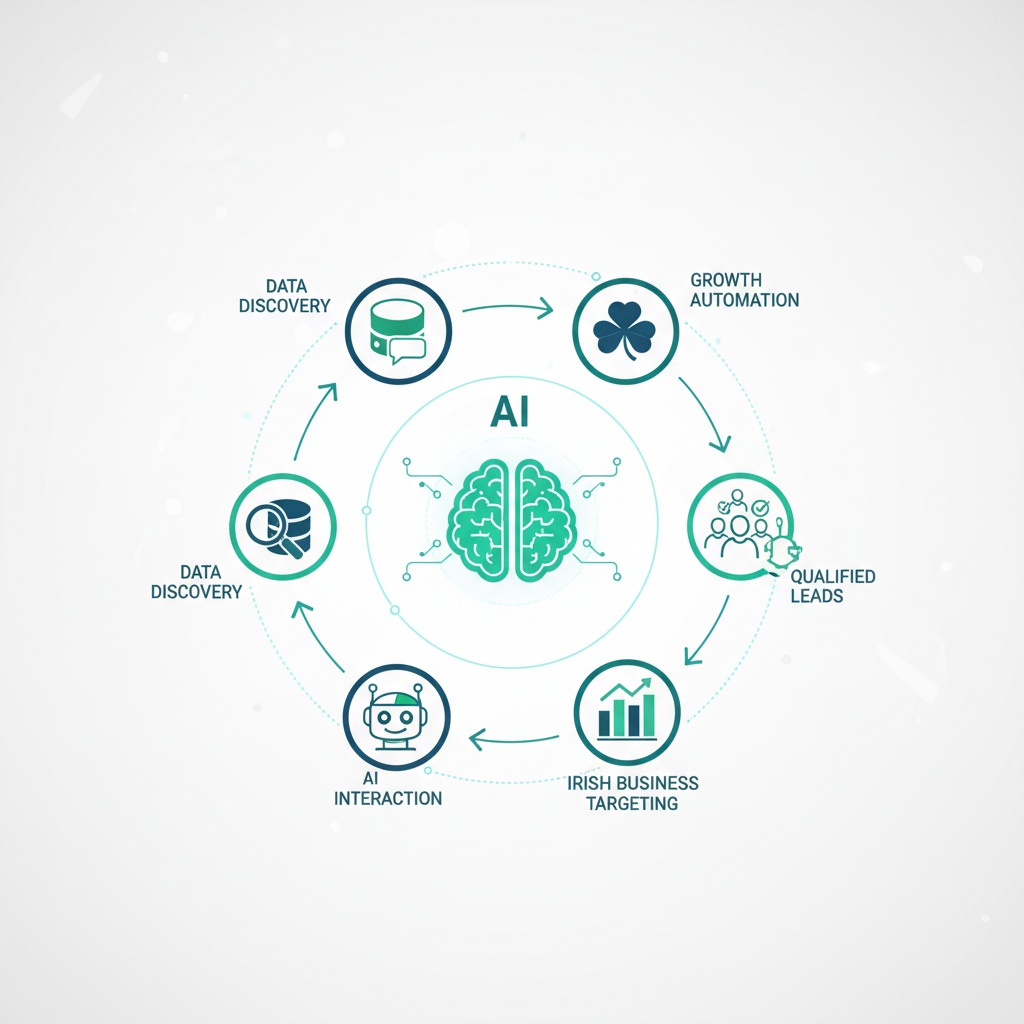
Generate High-Quality Leads with AI Sales Agents for Irish Business
In today's competitive landscape, generating high-quality leads is the lifeblood of any successful Irish business. The challenge, however, often lies in consistently identifying, engaging, and qualifying potential customers efficiently without draining valuable time and resources. This is where the power of Artificial Intelligence (AI) sales agents comes into play, offering a transformative approach to your lead generation strategy.
This comprehensive guide will walk you through the entire process of leveraging AI agents for small business, from defining your ideal customer to optimising your AI-powered campaigns, ensuring you attract prospects who are genuinely interested in what you offer. You'll learn how to implement these intelligent tools to streamline your sales funnel, enhance customer engagement, and ultimately drive sustainable growth for your Irish enterprise. By embracing these cutting-edge AI solutions, you can move beyond traditional, often time-consuming, lead generation methods and embrace a smarter, more targeted, and highly effective future.
What You'll Need
- A clear understanding of your business goals and target market.
- Access to customer data (CRM, website analytics, past sales records).
- Willingness to integrate new technology into existing workflows.
- A trusted AI solutions provider (like AISolutionsIreland) to guide implementation.
Step 1: Define Your Ideal Customer Profile (ICP) and Lead Qualification Criteria
Before you can effectively generate high-quality leads, you need a crystal-clear understanding of who your ideal customer is and what constitutes a "qualified" lead for your business. This foundational step is crucial because your AI sales agents will rely on this data to identify, engage, and filter prospects. Without a well-defined ICP, your AI efforts could target the wrong audience, leading to wasted resources and low conversion rates.
For Irish businesses, this might mean considering local market nuances, specific industry regulations, or even cultural preferences. Think beyond basic demographics to psychographics, pain points, aspirations, and the specific challenges your product or service solves. A detailed ICP acts as a blueprint, guiding your AI agents to seek out individuals and companies most likely to convert into loyal customers.
- Gather Existing Customer Data: Analyse your current customer base. Who are your most profitable, loyal, and satisfied customers? Look at their industry, company size, revenue, geographical location within Ireland, job titles, and specific challenges they faced before engaging with your business.
- Create Detailed Buyer Personas: Based on your data, develop 2-3 fictional, generalised representations of your ideal customers. Give them names, backstories, goals, pain points, and preferred communication channels. This humanises your target audience and makes it easier for AI to understand their needs.
- Establish Clear Qualification Criteria: Define what makes a lead "qualified." This often involves a combination of BANT (Budget, Authority, Need, Timeline) or similar frameworks. For example, a qualified lead might be a small business owner in Dublin with 10-50 employees, expressing a clear need for `ai workflow automation for small business`, and having a budget allocation for new software within the next six months.
- Identify Negative Personas: Just as important as defining who you want to attract is identifying who you don't. These are prospects who are unlikely to convert, too expensive to acquire, or won't be a good fit for your offering. Training your AI to recognise and filter these out can save significant time and resources.
Step 2: Choose the Right AI Sales Agent Tools and Platforms
Once you know who you're targeting, the next step is selecting the appropriate AI sales agent tools and platforms to execute your lead generation strategy. The market offers a range of AI solutions, from off-the-shelf SaaS products to custom-built agents. The choice depends on your specific needs, budget, and desired level of customisation and integration. For Irish businesses, ensuring GDPR compliance and local support can be key differentiators.
AISolutionsIreland specialises in providing custom AI agents tailored to how Irish businesses actually work. This ensures seamless integration into your existing operations and a solution designed specifically for your local market. Whether you need an AI to scour the web for prospects, engage via email, or qualify leads on your website, selecting the right technology is paramount.
- Assess Your Needs: What specific lead generation tasks do you want your AI agent to perform? Do you need it for initial outreach, lead scoring, personalised follow-ups, or qualifying inbound enquiries? This will determine the type of `small business ai assistant tools` you should consider.
- Evaluate Platform Capabilities: Research different AI sales agent platforms. Look for features like natural language processing (NLP) for effective communication, integration capabilities with your existing CRM (e.g., HubSpot, Salesforce), scalability, and analytics dashboards to track performance.
- Consider Custom vs. Off-the-Shelf: While off-the-shelf solutions can offer a quick start, custom AI agents, like those offered by AISolutionsIreland, provide unparalleled flexibility and precision. They can be trained on your unique data, understand local market nuances, and integrate deeply into your specific `ai workflow automation for small business`. This can be particularly beneficial for niche Irish markets or complex sales processes.
- Prioritise Security and Compliance: For Irish businesses, GDPR compliance is non-negotiable. Ensure any chosen platform or custom solution adheres strictly to data privacy regulations. AISolutionsIreland's OpenClaw service, for instance, offers private, secure, and fully-owned AI agents on a VPS with zero-trust VPN, ensuring data sovereignty and privacy.
- Factor in Cost and Support: Beyond initial setup fees, consider ongoing usage costs (if applicable) and the level of support provided. `Affordable ai agents for small businesses` should offer a clear return on investment. Look for providers that offer local, personal support, which can be invaluable during implementation and ongoing optimisation.
Step 3: Train Your AI Sales Agent with Relevant Data
The effectiveness of your AI sales agent hinges entirely on the quality and relevance of the data it's trained on. Think of your AI as a highly intelligent student; it can only perform as well as the curriculum you provide. This step involves feeding your AI agent with information that allows it to understand your products, services, target market, sales processes, and communication style.
For Irish businesses, this means using localised data where possible. This includes common customer queries, specific industry terminology, competitive landscapes relevant to Ireland, and even the tone of voice that resonates with your local audience. The more contextually rich and accurate your training data, the better your AI agent will become at identifying and engaging high-quality leads.
- Gather Comprehensive Sales and Marketing Collateral: Collect all relevant information, including product descriptions, service brochures, FAQs, past sales pitches, email templates, website content, and competitor analysis. This forms the knowledge base your AI will draw from.
- Provide Historical Lead Data: Feed your AI with data from past successful and unsuccessful leads. Include information on how leads were acquired, their engagement history, qualification scores, and conversion outcomes. This helps the AI learn patterns associated with high-quality leads.
- Supply Customer Interaction Transcripts: Utilise transcripts from customer support chats, sales calls, and email conversations. This teaches the AI about common customer questions, objections, and effective responses, enhancing its ability to handle initial interactions. This is especially crucial for `ai agents for customer support small business`.
- Define Communication Guidelines and Tone: Establish clear parameters for how your AI should communicate. Should it be formal, friendly, direct, or empathetic? Provide examples of appropriate and inappropriate responses to ensure brand consistency and cultural relevance for your Irish audience.
- Implement Feedback Loops: Crucially, set up a system for continuous feedback. When human sales team members interact with AI-qualified leads, their feedback (e.g., "this lead was highly qualified," "this lead was not a good fit") should be fed back into the AI's training data. This machine learning process ensures the AI continuously improves its performance.
Step 4: Integrate AI Agents into Your Existing Sales and Marketing Workflows
Deploying AI sales agents isn't about replacing your existing systems; it's about enhancing them. The true power of these tools comes from their seamless integration into your current sales and marketing workflows. This step ensures that your AI agents act as an extension of your team, automating routine tasks, providing timely insights, and freeing up human sales professionals to focus on relationship building and closing deals.
Effective `ai workflow automation for small business` means your AI agents can communicate with your CRM, email platforms, website, and other essential tools. This creates a cohesive ecosystem where data flows freely, ensuring no lead falls through the cracks and every interaction is informed by the most up-to-date information.
- Connect with Your CRM System: Integrate your AI agent directly with your CRM (e.g., HubSpot, Zoho, Salesforce). This allows the AI to automatically log interactions, update lead statuses, add notes, and create follow-up tasks for your human sales team. This ensures a single source of truth for all lead data.
- Automate Email Outreach: Configure your AI agent to send personalised initial outreach emails, follow-ups, or re-engagement campaigns based on predefined triggers or lead behaviour. These could be emails promoting specific products or services, or providing valuable content.
- Implement Website Chatbots: Deploy AI-powered chatbots on your website to instantly engage visitors, answer common questions, qualify leads based on their responses, and direct them to the appropriate sales representative or resource. This is a prime example of `how to use ai agents for business` to capture intent in real-time.
- Integrate with Marketing Automation Tools: Connect your AI agents with marketing automation platforms (e.g., Mailchimp, ActiveCampaign) to trigger specific content delivery, newsletter subscriptions, or event registrations based on lead interactions or qualification scores.
- Set Up Notification and Alert Systems: Configure your AI to notify your sales team immediately when a high-quality lead is identified, or when a lead takes a specific high-value action (e.g., downloads a whitepaper, requests a demo). This ensures timely human intervention when it matters most.
Step 5: Deploy AI Agents for Initial Lead Identification and Engagement
With your AI agents trained and integrated, it's time to put them to work. This step focuses on the initial stages of the lead generation funnel, where AI agents can proactively identify potential prospects and engage them effectively. This process significantly expands your reach and ensures that no valuable lead is overlooked.
AI agents excel at sifting through vast amounts of data and interacting with numerous prospects simultaneously, a task that would be impossible for a human team alone. Whether it's scanning public databases, social media, or engaging website visitors, these agents can initiate contact and gather crucial information to determine lead quality, making them powerful `ai agents for business` growth.
- Automated Prospect Research: Deploy AI agents to scour public databases, social media platforms (like LinkedIn), industry forums, and news articles for companies and individuals that match your ICP. These agents can identify triggers like new hires, funding rounds, or product launches that indicate a potential need for your services.
- Website Lead Qualification Chatbots: Implement a `ai agents for customer support small business` chatbot on your website. Configure it to greet visitors, answer common queries about your products or services, and ask a series of predefined questions to qualify their interest and needs. Based on their responses, the chatbot can direct them to relevant information, capture their contact details, or schedule a call with a human sales rep.
- Personalised Initial Outreach: Use AI to craft and send personalised introductory emails or messages to identified prospects. The AI can pull relevant details from its research to customise the message, making it more likely to resonate with the recipient. This helps in scaling targeted outreach efforts.
- Social Media Engagement: Deploy AI to monitor social media for mentions of your brand, industry keywords, or competitor activities. The AI can then initiate polite, helpful interactions, directing interested parties to your website or an appropriate resource.
- Virtual Assistant for Inbound Queries: Equip your AI agent to handle initial inbound enquiries from various channels (email, social media direct messages). It can answer routine questions, provide basic information, and filter out unqualified leads, only escalating genuinely interested prospects to your sales team.
Step 6: Leverage AI for Lead Nurturing and Qualification
Once a lead has been identified and engaged, the next critical step is nurturing them through the sales funnel and further qualifying their interest. This process often involves delivering relevant content, answering more specific questions, and understanding their pain points in greater detail. AI agents excel at this, providing continuous, personalised engagement that keeps your brand top-of-mind without requiring constant manual effort.
AI-driven nurturing ensures that leads receive the right information at the right time, increasing their readiness to speak with a human sales representative. This stage also leverages AI to score leads based on their engagement and fit, allowing your team to prioritise their efforts on the most promising prospects.
- Content Personalisation and Delivery: Use AI to analyse a lead's interactions (website visits, email opens, content downloads) and pain points to deliver highly personalised content. This could include blog posts, case studies, or whitepapers that directly address their specific needs. This is where `ai agents for content creation for small business` can play a pivotal role, by suggesting or even generating relevant content pieces.
- Automated Follow-Up Sequences: Set up AI-powered email drip campaigns or chatbot sequences that automatically trigger based on a lead's actions or inaction. If a lead opens an email but doesn't click a link, the AI can send a follow-up with additional value. If they download a specific resource, it can send related content.
- Dynamic Lead Scoring: Implement an AI-driven lead scoring model that continuously assesses a lead's likelihood to convert. The AI can factor in demographic data, engagement level, website behaviour, email interactions, and responses to chatbot questions to assign a score. High-scoring leads are then flagged for immediate human follow-up.
- Interactive Qualification Surveys: Design AI-guided interactive surveys delivered via chatbot or email. These surveys can delve deeper into a lead's budget, authority, needs, and timeline (BANT criteria), providing richer qualification data for your sales team.
- Scheduling Automation: Once a lead reaches a certain qualification threshold, the AI can automatically offer calendar links or integrate with your booking system to schedule a demo or consultation with a human sales representative, significantly reducing friction in the sales process.
Step 7: Analyze Performance and Optimise Your AI Sales Agents
The deployment of AI sales agents is not a "set it and forget it" endeavour. To truly maximise your return on investment and continuously improve your lead generation efforts, regular analysis and optimisation are essential. This final step involves monitoring key metrics, identifying areas for improvement, and iterating on your AI's strategies and training.
For Irish businesses, this means being agile and responsive to market changes or new insights gleaned from your AI's performance. Consistent optimisation ensures your AI agents remain effective, efficient, and aligned with your evolving business goals, helping you to truly master `how to use ai agents for business` success.
- Track Key Performance Indicators (KPIs): Monitor metrics such as the number of leads generated, lead quality scores, conversion rates at each stage of the funnel, cost per lead, and the time it takes to qualify a lead. AISolutionsIreland can help integrate analytics to track these vital statistics.
- Conduct A/B Testing: Experiment with different AI agent scripts, outreach messages, chatbot questions, and content delivery strategies. For example, test two different email subject lines or two different chatbot introductory messages to see which performs better in terms of engagement and lead qualification.
- Gather Human Feedback: Regularly collect feedback from your sales team regarding the quality of leads passed to them by the AI. Are they well-qualified? Is the information provided by the AI accurate and sufficient? Use this qualitative data to refine AI training and processes.
- Review and Refine AI Training Data: Periodically review the data your AI agents were trained on. Update it with new product information, changes in market conditions, or new customer insights. Remove outdated information and add new, relevant examples to keep the AI sharp.
- Adjust Lead Qualification Criteria: Based on performance analysis, you may need to adjust your lead qualification criteria. If the AI is generating many leads that don't convert, your criteria might be too loose. If it's generating very few leads, they might be too strict.
- Stay Updated with AI Advancements: The field of AI is rapidly evolving. Stay informed about new capabilities and features that could further enhance your AI sales agents' performance. Your AI solutions partner should be able to advise on these advancements.
Common Mistakes to Avoid
While AI sales agents offer incredible potential for lead generation, certain pitfalls can hinder their effectiveness. Being aware of these common mistakes can help your Irish business avoid setbacks and ensure a smoother, more successful implementation.
- Neglecting Your Ideal Customer Profile (ICP): Trying to be everything to everyone with your AI will lead to diluted efforts and low-quality leads. A fuzzy ICP means your AI won't know who to target effectively.
- Poor Quality Training Data: "Garbage in, garbage out" applies perfectly to AI. If your AI agents are trained on irrelevant, outdated, or biased data, their performance will suffer, leading to inaccurate lead qualification and poor engagement.
- Setting and Forgetting: AI agents require ongoing monitoring, analysis, and optimisation. Launching them without a plan for continuous improvement will result in diminishing returns and missed opportunities.
- Ignoring Human Oversight and Collaboration: AI is a tool to augment, not replace, your human sales team. Failing to integrate AI agents with human workflows or disregarding human feedback will create friction and limit the overall success of your lead generation strategy. A collaborative approach is key.
- Lack of Clear Objectives and KPIs: Without specific, measurable goals for your AI sales agents, it's impossible to determine their effectiveness or justify your investment. Define what success looks like before deployment.
- Over-reliance on Automation for Complex Issues: While AI can handle many tasks, complex negotiations, sensitive customer complaints, or highly nuanced sales conversations still often require human empathy and strategic thinking. Pushing AI beyond its capabilities can damage customer relationships.
- Neglecting Data Privacy and GDPR Compliance: For Irish businesses, ensuring all data collection, processing, and storage by AI agents is fully GDPR compliant is critical. Failure to do so can result in significant fines and reputational damage.
FAQ
How affordable are AI sales agents for small businesses in Ireland?
The affordability of AI sales agents for small businesses varies widely depending on the complexity of the solution. Basic off-the-shelf tools can have low monthly subscriptions, while custom-built, fully integrated agents require an initial investment. AISolutionsIreland offers solutions like OpenClaw with a one-time setup fee (€199) and pay-as-you-go usage, designed to be affordable and transparent for Irish SMEs, avoiding recurring subscription models. This makes high-quality `ai solutions` more accessible. For more details on pricing models, you can explore our FAQ on understanding the costs of AI agent solutions.
How quickly can AI agents be implemented and start generating leads for my Irish business?
The implementation timeline depends on the complexity of your requirements. For simpler tasks like a document-trained customer support chatbot, setup can be completed in a matter of days. Custom AI workflow development or more extensive integrations may take longer, typically weeks, not months. AISolutionsIreland prides itself on fast setup, with some services like OpenClaw being ready for launch in 24–48 hours, ensuring quick time-to-value for Irish businesses. Our approach to `ai workflow automation for small business` focuses on efficiency and rapid deployment.
What about data privacy and GDPR compliance for Irish businesses using AI sales agents?
Data privacy and GDPR compliance are paramount for Irish businesses. Any AI solution deployed must adhere to strict data protection regulations. AISolutionsIreland prioritises this by offering privacy-first and GDPR/EU compliant chatbots. Our OpenClaw service, for instance, provides private, secure, and fully-owned AI agents on a Virtual Private Server (VPS) with a zero-trust VPN, ensuring your data remains secure and sovereign. This commitment ensures your `ai agents for business` operate within legal and ethical boundaries.
Can AI agents replace my human sales team?
No, AI sales agents are designed to augment and empower your human sales team, not replace them. They excel at automating repetitive tasks like lead identification, initial qualification, data entry, and personalised nurturing, freeing up your sales professionals to focus on high-value activities such as complex negotiations, relationship building, and closing deals. AI handles the heavy lifting of `ai workflow automation for small business` in the early stages, allowing your team to concentrate on strategic sales activities.
What types of Irish businesses benefit most from using AI sales agents for lead generation?
Virtually any Irish business looking to scale its lead generation efforts and improve efficiency can benefit. This includes small and medium-sized enterprises (SMEs) across various sectors such as e-commerce, professional services, hospitality, manufacturing, and technology. Businesses with high volumes of inbound enquiries, those needing to expand their outreach without hiring more staff, or those struggling with lead qualification will see significant gains. Whether you need `ai agents for customer support small business` or `ai agents for content creation for small business`, the benefits are broad.
Next Steps
Ready to transform your lead generation and sales processes with intelligent AI agents tailored for your Irish business? Explore how AISolutionsIreland can help you implement custom AI solutions and `ai workflow automation for small business` to drive growth and efficiency. Contact us today for a consultation and discover how AI can work for you.