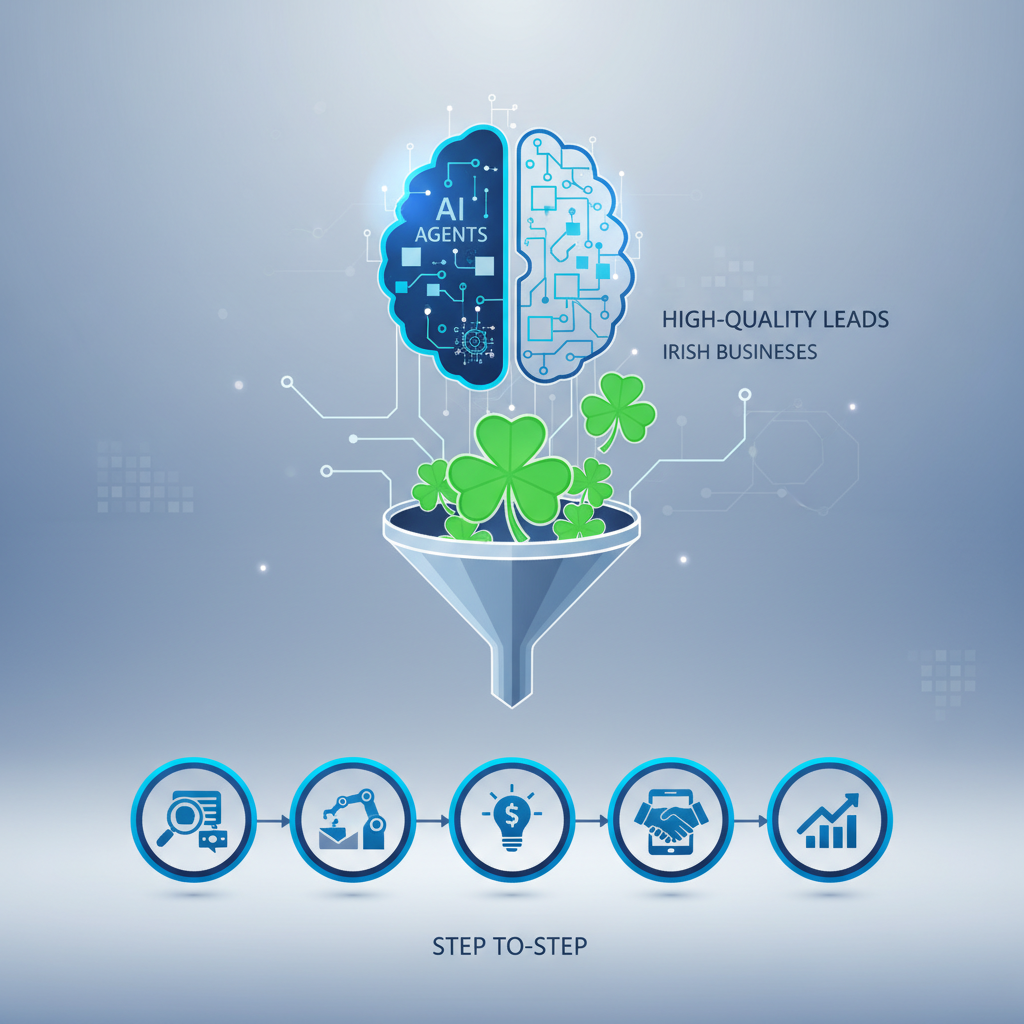
Generate High-Quality Leads with AI Agents: A How-To Guide for Irish Businesses
Introduction: Powering Your Irish Business with AI for Lead Generation
In today's competitive Irish market, acquiring high-quality leads consistently is the lifeblood of any growing business. Yet, for many small businesses and solo entrepreneurs, the process of lead generation can be incredibly time-consuming, resource-intensive, and often fraught with inefficiencies. From initial prospecting and data gathering to qualification and nurturing, manual lead generation drains valuable time and often leads to missed opportunities. Imagine a world where your lead generation efforts are streamlined, automated, and hyper-efficient, allowing your team to focus on what they do best: closing deals and building relationships.
This comprehensive guide will show you exactly how to harness the power of AI agents for lead generation, transforming your approach to customer acquisition. We'll delve into practical, actionable steps to deploy intelligent AI assistants that can identify, engage, and qualify potential customers around the clock. You'll learn how to integrate these powerful tools into your existing workflows, ensuring a seamless experience that boosts efficiency and drives growth for your Irish business. Whether you're a small business owner looking to scale, a marketing manager aiming to optimise campaigns, or a solo entrepreneur seeking a personal ai assistant for productivity, understanding how to leverage AI agents effectively is no longer a luxury – it's a necessity. Prepare to discover how custom AI agents can revolutionise your sales funnel, providing a sustainable competitive edge.
Who This Is For
- Irish Small Business Owners & SMEs looking to scale their customer acquisition.
- Marketing Managers seeking to optimise lead generation campaigns and reduce manual effort.
- Sales Teams aiming to receive higher-quality, pre-qualified leads.
- Solo Entrepreneurs who need to maximise productivity and automate repetitive tasks.
- Anyone interested in leveraging cutting-edge technology to streamline business operations and drive growth.
Step 1: Define Your Lead Generation Goals and Ideal Customer Profile (ICP)
Before you even think about deploying AI agents, it's paramount to have a crystal-clear understanding of what you want to achieve and who you want to reach. Just like building a house, you need a solid blueprint. Without defined goals and a precise Ideal Customer Profile (ICP), your AI agents will be working blindly, generating leads that may not be a good fit for your business, leading to wasted resources and frustrating results. This foundational step ensures that your AI efforts are strategically aligned with your business objectives.
Consider the types of leads you currently attract, their pain points, and why they choose your product or service. This insight is invaluable for training your AI agents to recognise and prioritise similar prospects. Furthermore, defining specific, measurable, achievable, relevant, and time-bound (SMART) goals for your lead generation will provide a clear benchmark for success, allowing you to accurately track the performance of your AI agents and make data-driven adjustments.
- Outline SMART Lead Generation Goals:
- Increase qualified lead volume by X% in Y months.
- Reduce lead acquisition cost by Z%.
- Improve lead-to-opportunity conversion rate by A%.
- Automate X hours per week spent on initial lead qualification.
- Develop a Detailed Ideal Customer Profile (ICP):
- Demographics: Industry, company size (e.g., small businesses, medium-sized enterprises), revenue, location (e.g., businesses in Dublin, Cork, Galway).
- Firmographics: Technologies used, current challenges, pain points your product/service solves.
- Behavioral: Online activity, content consumed, engagement with competitors.
- Create Buyer Personas: Build 2-3 detailed fictional representations of your key customer segments, including their roles, goals, motivations, and common objections.
- Identify Key Qualification Criteria: Determine the essential characteristics that define a "good" lead for your business. This will be crucial for training your AI agents to effectively qualify prospects.
Tip: Don't try to target everyone. A narrowly defined ICP allows your AI agents to be far more effective in finding and engaging the right prospects, leading to higher conversion rates and better ROI.
Step 2: Identify Manual Lead Generation Bottlenecks and Opportunities for Automation
Most businesses, especially small businesses and solo entrepreneurs, have existing lead generation processes that involve significant manual effort. These are often the areas ripe for AI-driven automation. Before you look to buy ai agent software for business, you need to pinpoint exactly where time, money, and human resources are being inefficiently spent. This step involves a thorough audit of your current lead generation funnel, from initial contact to hand-off to sales.
Think about the repetitive tasks that consume your team's time – things that could be done faster and more consistently by an AI. Are your sales reps spending hours sifting through unqualified leads? Is your marketing team manually researching companies? Is follow-up email outreach inconsistent? By identifying these bottlenecks, you can strategically apply ai agents for small business automation, ensuring that your investment delivers tangible improvements where they're needed most.
- Map Your Current Lead Generation Process: Document every step, from initial discovery to lead qualification and nurturing. Use flowcharts or simple bullet points to visualise the journey.
- Pinpoint Time-Consuming Tasks: Identify activities that take up significant human time but are repetitive and rule-based. Examples include:
- Manual data entry into CRM systems.
- Initial lead qualification based on predefined criteria.
- Researching company information or contact details.
- Sending initial outreach or follow-up emails.
- Answering basic, frequently asked questions from prospects.
- Scheduling introductory calls or demos.
- Summarising research findings.
- Identify Gaps and Missed Opportunities: Where are leads falling through the cracks? Are there periods when no one is available to respond to inquiries? Are prospects dropping off due to slow follow-up?
- Quantify the Impact: Estimate the amount of time and resources currently spent on these manual tasks. This will help you build a business case for implementing AI and demonstrate its ROI.
Warning: Don't automate a broken process. If your current manual process is fundamentally flawed, automating it will only amplify the issues. Streamline and refine your human-led process first, then introduce AI to enhance it.
Step 3: Choose the Right AI Agent Solutions for Your Specific Needs
With a clear understanding of your goals and identified bottlenecks, the next step is to select the appropriate AI agent solutions. The market offers a wide array of tools, from specialised AI agents for customer support small business to sophisticated systems designed for complex data analysis. Your choice will depend on the specific problems you identified in Step 2 and the resources you have available.
Consider whether you need a comprehensive platform or targeted, custom ai agents for small business that address particular pain points. AISolutionsIreland, for instance, offers various AI agents designed for Irish businesses, including document-trained customer support chatbots, AI for creating and sending sales promotional emails, and custom AI workflow development. Understanding the difference between off-the-shelf SaaS solutions and custom-built agents is crucial for long-term success, as explored in our resources on custom AI agents vs. off-the-shelf SaaS.
- Categorise Your Automation Needs: Based on Step 2, group the tasks you want to automate into categories (e.g., initial outreach, lead qualification, research, scheduling).
- Explore AI Agent Types Relevant to Lead Generation:
- AI Chatbots: For website visitor engagement, answering FAQs, and initial lead qualification. Excellent as AI agents for customer support small business and pre-sales.
- Email AI Agents: To automate personalised email outreach, follow-ups, and managing responses. Ideal as an ai assistant for managing emails and calendar.
- Data Scraping/Research AI Agents: For gathering prospect data from public sources (websites, LinkedIn), summarising company information, and identifying key contacts. Perfect for ai agents for research and summarization.
- Lead Scoring AI: To analyse prospect data and assign a score based on their likelihood to convert.
- Appointment Scheduling AI: To manage calendars and book meetings automatically with qualified leads.
- CRM Integration Agents: To seamlessly transfer lead data from various sources into your CRM.
- Evaluate Custom vs. Off-the-Shelf Solutions:
- Off-the-Shelf: Quicker to implement, generally subscription-based, less customisation. Good for generic tasks.
- Custom AI Agents: Tailored precisely to your unique workflow and data. Offers maximum flexibility and often better integration. Solutions like AISolutionsIreland's OpenClaw service provide private, secure, and fully-owned AI agents, avoiding recurring subscriptions for core functionality.
- Consider Budget and Scalability: Factor in initial setup costs (like the €199 one-time fee for OpenClaw) and ongoing usage fees. Ensure the solution can grow with your business.
Tip: For Irish businesses, especially SMEs, custom AI agents often provide a superior long-term solution. They fit into existing workflows ("AI that works the way you do") and are designed locally with personal support, ensuring GDPR and EU compliance from the outset. Don't be afraid to invest in custom ai agents for small business that are built to your specifications.
Step 4: Configure and Train Your AI Lead Generation Agents
Once you've selected your AI agents, the next critical step is to configure and train them to perform their designated tasks effectively. This isn't a "set it and forget it" process; the quality of your AI's output directly correlates with the quality of its training data and configuration. Think of it as teaching a new employee: you need to provide clear instructions, relevant information, and examples to ensure they understand their role and responsibilities.
For lead generation, this means feeding your AI agents with your ICP, buyer personas, qualification criteria, and any other data that helps them identify and engage potential customers. Whether you're setting up a no-code AI agent for small business or integrating a more complex system, this step is where you imbue your AI with the intelligence it needs to excel.
- Define Agent Roles and Parameters:
- For chatbots: Script conversational flows, define qualification questions, set triggers for human handover.
- For email agents: Craft email templates, set up A/B testing parameters, define follow-up logic, integrate with your CRM.
- For research agents: Specify data sources, define search queries, outline desired information extraction (e.g., company size, decision-maker names, industry news).
- Provide High-Quality Training Data:
- Customer Data: Use anonymised data from existing good leads and customers.
- Product/Service Information: Ensure the AI has comprehensive knowledge of your offerings.
- FAQs: Equip customer support chatbots with common queries and expert answers.
- ICP & Persona Data: Explicitly input the criteria defining your ideal customers.
- Integrate with Existing Tools: Connect your AI agents with your CRM (e.g., HubSpot, Salesforce), marketing automation platforms (e.g., Mailchimp, Klaviyo), and calendar systems. This ensures seamless data flow and efficient lead management. This integration is crucial for ai agents for small business automation.
- Set Up Testing Environments: Before full deployment, run internal tests to ensure your AI agents understand commands, respond appropriately, and perform tasks accurately.
Warning: "Garbage in, garbage out." The effectiveness of your AI agents is directly proportional to the quality and relevance of the data you use to train them. Poor or biased data will lead to inaccurate results and unqualified leads.
Step 5: Deploy Your AI Agents Across Lead Touchpoints
With your AI agents configured and trained, it's time to unleash them where they can make the most impact: across your various lead touchpoints. This involves strategically placing your AI where prospective customers interact with your brand, ensuring they can capture, engage, and qualify leads round the clock. Effective deployment can transform your website from a static brochure into an interactive lead generation machine, or turn your email campaigns into highly responsive outreach efforts.
For Irish businesses, this means ensuring your AI is accessible and responsive to local inquiries, understanding local nuances if programmed to do so. Whether it's a website chatbot or an AI-powered email sequence, the goal is to create a seamless, efficient, and intelligent interaction for every potential lead, often leveraging tools like no-code ai agents for small business platforms for easier implementation.
- Website Integration (Chatbots):
- Embed your AI chatbot on key landing pages, product pages, and your contact page.
- Program it to proactively engage visitors, answer common questions, collect contact information, and qualify leads based on predefined criteria. Consider it as an initial line of AI agents for customer support small business.
- Ensure a clear path for human handover if the AI cannot resolve an inquiry or a lead reaches a certain qualification threshold.
- Email Marketing & Outreach:
- Utilise AI agents to personalise email content, optimise send times, and automate follow-up sequences based on recipient engagement.
- Employ AI to analyse email responses, categorise replies (e.g., "interested," "not interested," "needs more info"), and trigger appropriate actions. This is where ai agents for solo entrepreneurs and small businesses truly shine in managing communications.
- Social Media Engagement:
- Deploy AI agents to monitor social media for mentions of your brand, industry keywords, or competitor discussions.
- Program them to respond to basic inquiries, direct users to relevant content, or capture lead information through direct messages.
- Content Distribution & Research:
- Use ai agents for research and summarization to identify relevant online communities or publications where your content can reach your ICP.
- Automate the scheduling and posting of content across various platforms.
Tip: Start small with one or two key touchpoints where you anticipate the biggest impact. Monitor performance closely before expanding to other areas. This iterative approach allows for fine-tuning and reduces potential disruption.
Step 6: Monitor, Analyse, and Optimise AI Agent Performance
Deploying AI agents for lead generation is not a one-time task; it's an ongoing process of monitoring, analysis, and optimisation. Just like any marketing or sales initiative, your AI agents need continuous attention to ensure they are performing at their peak and adapting to changing market conditions or customer behaviors. Without this crucial step, your AI might become less effective over time, leading to diminishing returns.
Regularly reviewing the data generated by your AI agents will provide invaluable insights into what's working and what isn't. This allows you to refine your strategies, improve your AI's training, and ultimately drive better lead quality and conversion rates. This continuous feedback loop is essential for maximising the effectiveness of your ai agents for small business automation.
- Track Key Performance Indicators (KPIs): Monitor metrics relevant to your lead generation goals, such as:
- Number of leads generated by AI.
- Lead qualification rate.
- Lead-to-opportunity conversion rate for AI-generated leads.
- Cost per qualified lead (CPL).
- Response times (for chatbots or email agents).
- Engagement rates (for AI-driven outreach).
- Time saved by human teams due to automation.
- Gather Feedback:
- From Leads: If applicable, gather explicit feedback on their interaction with the AI.
- From Sales Team: Solicit feedback on the quality of AI-qualified leads and the information provided.
- From AI: Many advanced AI platforms offer analytics on their performance, common queries, and areas of confusion.
- Analyse Data for Insights:
- Identify patterns in successful lead interactions.
- Pinpoint common drop-off points or areas where the AI struggles.
- Look for discrepancies between AI-generated leads and human-generated leads.
- Iterate and Refine:
- Retrain Your AI: Update training data, conversation flows, and qualification criteria based on performance insights.
- A/B Test: Experiment with different AI prompts, messaging, or qualification questions to optimise effectiveness.
- Adjust Integration: Fine-tune how your AI agents hand off leads to your human team or integrate with other systems.
Tip: Don't be afraid to experiment. AI performance improves with data and iterative adjustments. Treat your AI agents as evolving team members that need continuous coaching and support to reach their full potential.
Step 7: Integrate AI Agents with Your Existing Sales Workflow
The ultimate goal of using AI agents for lead generation isn't to replace your human sales team, but to empower them. Seamless integration with your existing sales workflow ensures that the valuable leads identified and qualified by AI are efficiently handed over to your human experts for conversion. This harmony between AI efficiency and human empathy is where true business growth lies, especially for businesses leveraging custom ai agents for small business designed to fit their specific needs.
A poorly integrated AI system can cause friction, lead to dropped leads, and frustrate your sales team. Conversely, a well-integrated system makes your sales team more productive, allowing them to focus on high-value interactions rather than manual grunt work. This final step is crucial to ensure that your investment in ai agents for lead generation translates into actual revenue.
- Define Clear Handoff Protocols:
- Establish specific criteria for when an AI-qualified lead should be handed over to a human sales representative.
- Determine the preferred communication method for handoff (e.g., CRM notification, direct message, email alert).
- Ensure Data Flow to CRM:
- Verify that all lead data collected by your AI agents (contact information, qualification answers, interaction history) is automatically and accurately transferred to your Customer Relationship Management (CRM) system.
- This provides your sales team with a complete picture of the lead before they make contact. Solutions that provide an ai assistant for managing emails and calendar often excel at this.
- Train Your Sales Team:
- Educate your sales representatives on how the AI agents work, what information they collect, and how to interpret AI-generated lead scores or summaries.
- Provide guidance on how to follow up with AI-qualified leads effectively, leveraging the data provided by the AI.
- Address any concerns or resistance, highlighting how AI empowers them to be more effective.
- Leverage AI for Post-Qualification Support:
- Use AI to generate quick summaries of lead interactions for sales reps, saving them time on research.
- Implement AI to schedule follow-up appointments or send personalised reminders, functioning as a personal ai assistant for productivity for your sales team.
- Establish a Feedback Loop: Create a system for your sales team to provide feedback on the quality of AI-generated leads directly back to the AI management team. This continuous feedback is vital for ongoing optimisation.
Warning: Avoid the temptation to over-automate the entire sales process. The human touch remains critical for building rapport, understanding complex needs, and closing deals. AI should augment, not fully replace, human interaction in the later stages of the sales funnel.
Common Mistakes to Avoid When Deploying AI Agents for Lead Generation
Implementing AI for lead generation can be transformative, but it's not without its pitfalls. Avoiding common mistakes will save you time, resources, and frustration, ensuring a smoother journey and better results for your Irish business.
- Failing to Define Clear Goals and ICP: Without a precise target, your AI will generate quantity over quality, leading to unqualified leads and wasted effort. As discussed in Step 1, clarity here is non-negotiable.
- Ignoring Data Quality: AI is only as good as the data it's fed. Using inaccurate, incomplete, or biased data will result in flawed decision-making by your agents and poor lead quality.
- Expecting AI to be 100% Autonomous Immediately: AI requires training, monitoring, and ongoing optimisation. It's an iterative process, not a "set it and forget it" solution. Start with realistic expectations.
- Neglecting Integration with Existing Systems: Siloed AI agents that don't communicate with your CRM, marketing automation, or other sales tools will create more work and lead to inefficiency rather than solving it.
- Over-Automating Human Touchpoints: While AI excels at repetitive tasks, complex sales negotiations and building deep customer relationships still require a human touch. Know when to hand off to your sales team.
- Not Prioritising GDPR and Data Privacy: For Irish businesses, ensuring your AI agents handle data in a GDPR-compliant manner is critical. This includes how data is collected, stored, and used. Privacy-first design is a core differentiator for solutions like those offered by AISolutionsIreland.
- Skipping Continuous Monitoring and Optimisation: Market conditions, customer behavior, and your offerings change. Your AI agents need regular review and adjustment to remain effective.
- Lack of Internal Team Training: If your sales and marketing teams aren't trained on how to work with the AI agents, they won't be able to leverage the benefits effectively, leading to friction and underperformance.
- Choosing the Wrong Tool for the Job: Opting for a generic, off-the-shelf solution when your business has unique, complex needs can be a costly mistake. Sometimes custom ai agents for small business are a far better investment.
FAQ: AI Agents for Lead Generation
How much do AI agents for lead generation cost for an Irish SME?
The cost of AI agents for lead generation can vary significantly based on the complexity, customisation, and scale of the solution. Basic off-the-shelf tools might have monthly subscription fees ranging from tens to hundreds of Euros. Custom AI solutions, like those offered by AISolutionsIreland, typically involve a one-time setup fee (e.g., €199 for OpenClaw) plus usage-based costs, avoiding recurring subscriptions for core services. This model offers greater cost predictability and scalability, making it an attractive option for Irish SMEs seeking tailored solutions without being tied to long-term contracts. For a deeper dive into costs, you can explore understanding the costs of AI agent solutions for Irish SMEs.
Are AI agents effective for B2B or B2C lead generation?
Yes, AI agents are highly effective for both B2B and B2C lead generation, though their application might differ. For B2B, AI agents excel at tasks like in-depth company research, identifying key decision-makers, initial qualification based on firmographic data, and automating personalised outreach. For B2C, they are powerful for instant customer service (chatbots), rapid lead capture on websites, segmenting prospects based on behaviour, and personalising mass marketing campaigns. The key is to tailor the AI agent's training and deployment to the specific nuances of your target market.
How long does it take to implement AI agents for lead generation?
The implementation timeline for AI agents can range from a few days to several weeks, depending on the complexity and level of customisation. Simple, off-the-shelf chatbots can often be deployed within days. More complex custom ai agents for small business, especially those requiring deep integration with existing systems and extensive training data, might take 2-4 weeks for full implementation and fine-tuning. AISolutionsIreland prioritises fast setup, often getting agents ready in 24-48 hours, highlighting a commitment to quick integration for Irish small businesses, as discussed in how quickly AI agents can integrate.
Can AI agents replace my sales team for lead generation?
No, AI agents are designed to augment and empower your sales team, not replace them. They handle the repetitive, time-consuming tasks of lead identification, qualification, and initial nurturing, freeing up your human sales reps to focus on high-value activities like building relationships, understanding complex client needs, and closing deals. AI ensures your sales team receives higher-quality, pre-qualified leads, making their efforts more efficient and productive. It's about creating a synergistic relationship where AI handles the heavy lifting, and humans bring the irreplaceable elements of empathy and strategic insight.
How do AI agents handle data privacy and GDPR compliance for Irish businesses?
For Irish businesses, GDPR compliance is paramount. Reputable AI agent providers, like AISolutionsIreland, design their solutions with privacy first and ensure full GDPR and EU compliance. This includes aspects like secure data handling, transparent data collection practices, obtaining explicit consent where necessary, and providing users with control over their data. Custom AI solutions, such as OpenClaw, often run on private Virtual Private Servers (VPS) with zero-trust VPNs, ensuring that your data remains fully owned and controlled by you, reducing third-party data risks and enhancing security.
Next Steps: Unlock Your Lead Generation Potential Today
Ready to transform your lead generation and sales processes with the power of intelligent AI agents? AISolutionsIreland specialises in building custom AI solutions tailored for Irish businesses, designed to integrate seamlessly into your existing workflows. Don't let valuable leads slip away – explore how our expert team can help you generate high-quality leads efficiently and sustainably.
Visit our AI Sales Agents Guide or contact us today to discuss your specific lead generation challenges and discover how custom AI agents can drive tangible growth for your business.