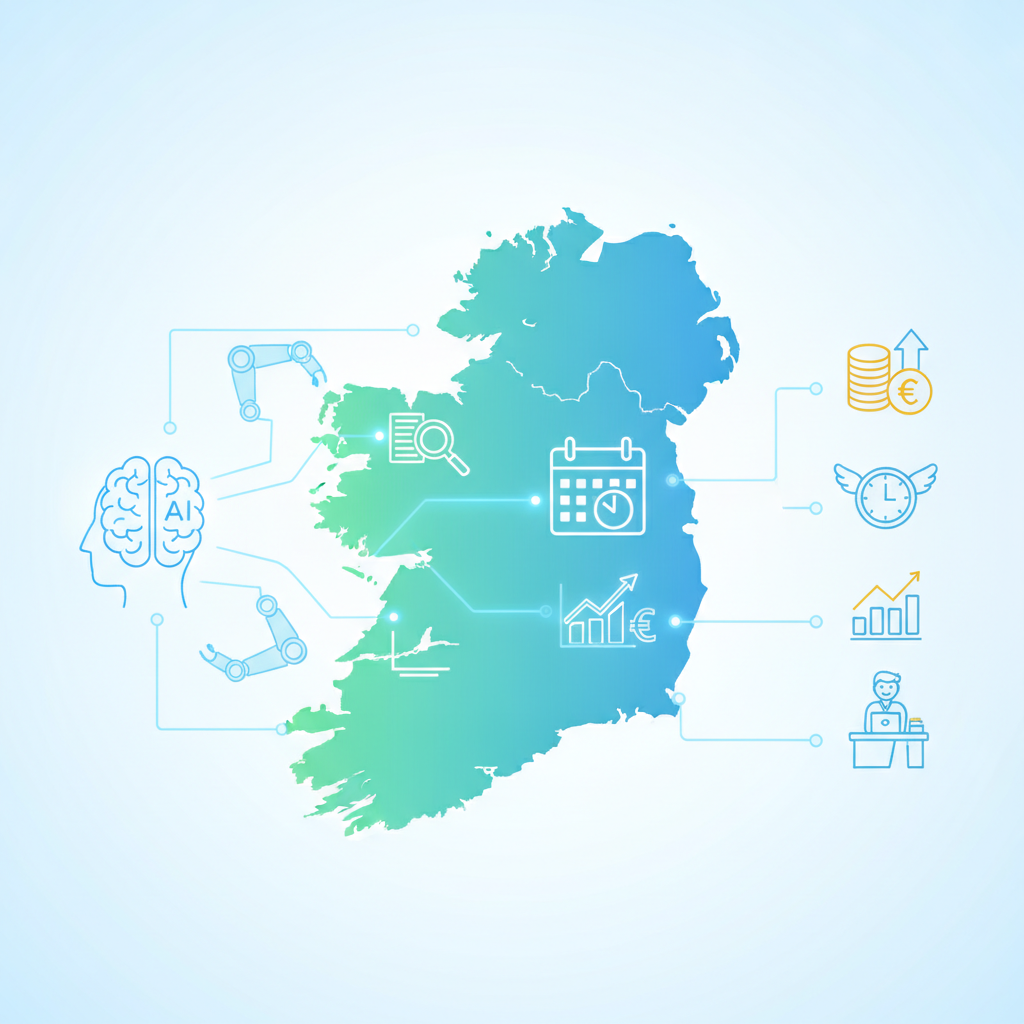
Automate Essential Admin Tasks for Your Irish Business with AI Agents
In today's fast-paced business environment, administrative tasks can consume an astonishing amount of time and resources, particularly for small businesses and entrepreneurs across Ireland. From managing emails and scheduling appointments to handling routine customer inquiries and data entry, these essential but often repetitive duties can divert valuable energy away from core business growth activities. But what if there was a way to reclaim that time, boost efficiency, and allow your team to focus on what truly matters? Enter AI agents – your new secret weapon for administrative automation.
This comprehensive guide will walk you through the practical steps of identifying, implementing, and optimising AI agents to automate essential administrative tasks for your Irish business. We'll explore how these intelligent tools can revolutionise your daily operations, providing tangible benefits like reduced overheads, increased productivity, and enhanced customer satisfaction. Whether you're an ambitious startup in Dublin or a long-established SME in Cork, learning to harness the power of AI automation tools Ireland offers can put you significantly ahead of the curve. Get ready to transform your approach to business administration, making your workflows smarter, faster, and more effective. By the end, you'll understand how to leverage your first AI agent to drive real, measurable improvements for your enterprise.
Who This Is For
- Irish small business owners seeking to reduce operational costs and free up staff time.
- Entrepreneurs and freelancers looking to streamline personal and professional admin.
- Office managers aiming to improve efficiency and workflow for small Irish offices.
- Anyone interested in leveraging cutting-edge AI solutions for practical, everyday business challenges.
Step 1: Identify Your Administrative Bottlenecks and Prioritise Automation
The first crucial step in automating administrative tasks with AI agents is to thoroughly understand your current workflows and pinpoint where time, effort, and resources are being disproportionately spent. This initial audit isn't just about identifying tasks; it's about uncovering the "why" behind those bottlenecks and assessing their impact on your business's overall productivity and profitability. For many Irish businesses, particularly SMEs, administrative inefficiencies often go unnoticed because they're simply "how things have always been done."
Start by mapping out a typical week or month for your administrative staff or for yourself if you're a solopreneur. Document every repetitive task, no matter how small. Think about tasks that require consistent manual input, routine decision-making, or frequent communication that follows a predictable pattern. These are the prime candidates for AI automation. Prioritisation should then be based on impact: Which tasks consume the most time? Which are most prone to human error? Which, if automated, would free up staff for higher-value activities or directly improve customer experience?
- Conduct a Workflow Audit: List all administrative tasks performed weekly or monthly. Categorise them by department (e.g., customer service, marketing, HR, finance) and by type (e.g., data entry, scheduling, email correspondence, report generation).
- Measure Time and Frequency: Estimate the average time spent on each task and how frequently it occurs. Quantify the cumulative hours dedicated to repetitive admin across your team.
- Identify Repetitive and Rule-Based Tasks: Look for tasks that involve moving data between systems, answering common questions, sending standard emails, or scheduling based on set criteria. These are ideal for AI agents.
- Assess Impact and Pain Points: Determine which tasks cause the most frustration, delays, or errors. Consider the opportunity cost – what could your team be doing if these tasks were automated?
- Prioritise Automation Candidates: Rank tasks based on potential time savings, error reduction, and strategic value. Focus on high-frequency, low-complexity tasks first for quick wins.
Tip: Engage your team in this process. Those on the front lines often have the best insights into inefficient processes and can suggest excellent candidates for automation. Their buy-in will also be crucial for successful implementation.
Step 2: Understand AI Agent Capabilities and Choose the Right Solution
Once you've identified your primary administrative bottlenecks, the next step is to understand what AI agents truly are and how they differ from simpler automation tools. AI agents are not just glorified macros; they are sophisticated software entities capable of understanding context, making decisions, learning from interactions, and performing complex tasks with minimal human intervention. They can execute multi-step processes, interact with various systems, and even communicate naturally with users, making them powerful tools for AI workflow for small Irish offices.
Choosing the right AI solution is paramount. For many Irish entrepreneurs and small businesses, the choice often comes down to off-the-shelf SaaS solutions versus custom-built AI agents. While off-the-shelf tools can offer quick deployment for generic tasks, they may lack the specific functionality or integration capabilities required for your unique business processes. Custom AI agents, like those offered by AISolutionsIreland, are designed around your existing workflows, providing a more seamless and powerful automation experience that truly works the way you do. This often involves leveraging advanced AI models to create bespoke solutions tailored to your specific needs, ensuring privacy-first and GDPR/EU compliance.
- Research AI Agent Types: Familiarise yourself with different kinds of AI agents, such as chatbots for customer support, virtual assistants for scheduling, and process automation agents for data handling.
- Evaluate Off-the-Shelf vs. Custom Solutions: Consider if generic AI software can meet your needs or if a tailored solution that integrates deeply with your unique systems and processes is required. For specific, complex admin tasks, custom AI agents often yield better results. You can read more about this decision here.
- Prioritise Key Features: Look for features like natural language processing (NLP), integration capabilities with your existing software (CRM, email, calendar), learning capabilities, and robust security protocols (especially important for Irish and EU businesses needing GDPR compliance).
- Consider Scalability and Support: Ensure the chosen solution can grow with your business and that you have access to reliable local support. For Irish businesses, having local support can be a significant advantage.
- Set a Realistic Budget: Factor in initial setup costs, ongoing maintenance, and potential usage fees. Solutions like OpenClaw offer a one-time setup fee, which can be more budget-friendly for small businesses than recurring subscriptions.
Warning: Be wary of "one-size-fits-all" AI solutions that promise to solve all your problems without understanding your specific business context. A customised approach often delivers much greater ROI.
Step 3: Implement AI for Email and Communication Management
Email management is one of the most time-consuming administrative tasks for nearly every business. An overflowing inbox can be a major source of stress and inefficiency, distracting staff from their core duties. AI agents for email management can revolutionise how your Irish business handles communications, turning a daunting daily chore into a streamlined, automated process. These agents can learn to categorise, prioritise, draft responses, and even schedule follow-ups, ensuring important messages are never missed and routine inquiries are handled promptly.
Imagine an AI agent sifting through your incoming emails, flagging urgent client requests, moving promotional emails to a separate folder, and even drafting initial replies to common questions based on your predefined knowledge base. This not only saves countless hours but also ensures consistency in communication and reduces the likelihood of human error. It allows your team to focus their attention on complex queries and strategic communication, rather than being bogged down by inbox triage. This level of automation is an essential `ai automation tool Ireland` businesses can leverage for significant gains.
- Integrate with Your Email System: Connect your chosen AI agent platform with your existing email provider (e.g., Gmail, Outlook 365). This is often done via APIs or dedicated connectors.
- Define Categorisation Rules: Train the AI to recognise and categorise incoming emails based on sender, keywords, subject lines, and content. For example, automatically move supplier invoices to an "Accounts" folder or customer support queries to a dedicated queue.
- Set Up Prioritisation Logic: Configure the AI to highlight or escalate emails from key clients, urgent requests, or specific keywords that indicate high priority.
- Automate Draft Responses: Develop a library of common email responses and train the AI to draft replies to frequently asked questions (FAQs) or standard requests. Human oversight can then review and send these drafts, saving significant writing time.
- Schedule Follow-ups and Reminders: Instruct the AI to set calendar reminders for emails requiring a follow-up or to automatically send gentle nudges if a response is awaited.
Tip: Start by automating the most common and repetitive email interactions. Observe the AI's performance and provide feedback to help it learn and improve its accuracy over time. Consider how AI agents for email management can be seamlessly integrated into your daily workflow.
Step 4: Deploy AI Agents for Customer Support and FAQs
Customer support is a critical area where AI agents can deliver immediate and substantial value to Irish businesses. Many small businesses grapple with limited resources, making it challenging to provide 24/7 support or handle a high volume of routine inquiries. AI agents, specifically document-trained customer support chatbots, can address these challenges by providing instant, accurate answers to common questions, freeing up human staff to tackle more complex or sensitive issues. This elevates the customer experience while optimising your operational costs.
By training an AI agent on your company's knowledge base, FAQs, product manuals, and service guidelines, you can create a highly effective virtual assistant capable of understanding natural language queries and providing relevant information in real-time. This not only improves response times but also ensures consistency in the information provided. For Irish businesses, implementing `ai agents for customer support small business` can significantly enhance service quality and customer satisfaction, turning potential frustrations into positive interactions. Our guide to deploying an AI chatbot can provide further insights.
- Gather Your Knowledge Base: Compile all existing FAQs, support articles, product documentation, and common customer queries into a structured format. This will be the training data for your AI agent.
- Choose a Chatbot Platform: Select an AI chatbot solution that integrates with your website, social media, or messaging apps. AISolutionsIreland offers privacy-first, GDPR/EU compliant chatbots that are trained on your specific documents.
- Train Your AI Chatbot: Feed your compiled knowledge base into the AI. Ensure it understands the nuances of your products/services and can provide accurate, contextually relevant answers.
- Define Escalation Paths: Configure the chatbot to identify when a query requires human intervention and seamlessly transfer the customer to a live agent or create a support ticket.
- Test and Refine: Rigorously test the chatbot with a variety of questions and scenarios. Monitor its interactions, gather feedback, and continuously refine its responses and capabilities.
Warning: While AI agents are powerful, they should augment, not entirely replace, human customer support. Ensure there's always an option for customers to speak with a human agent for complex or sensitive issues.
Step 5: Streamline Scheduling and Calendar Management with AI
The back-and-forth of scheduling meetings, appointments, and consultations can be an enormous time sink for any business, especially for client-facing roles. Manually coordinating availability, sending invitations, and managing reminders is a tedious and error-prone administrative task. This is where AI agents can significantly simplify your life and business operations. An `ai assistant for daily planning` can intelligently manage your calendar, find optimal meeting times, send invites, and even handle rescheduling, all with minimal input from you or your team.
For small Irish businesses, automating scheduling means less time on administrative logistics and more time focused on clients, sales, or project execution. This is particularly valuable for service-based businesses, consultants, and sales teams who rely heavily on appointments. AI agents can integrate directly with your calendar, understand your preferences and availability, and autonomously interact with others to secure meeting times that suit everyone. Explore our guide on AI agents for booking and scheduling for a detailed walkthrough.
- Integrate with Your Calendar: Connect the AI agent with your primary calendar application (e.g., Google Calendar, Outlook Calendar).
- Define Availability and Preferences: Set your working hours, preferred meeting lengths, buffer times between appointments, and any specific rules (e.g., no meetings before 10 AM on Mondays).
- Automate Appointment Booking: Allow the AI agent to share your real-time availability with clients or colleagues, letting them pick a suitable time without direct back-and-forth emails.
- Send Automated Invites and Reminders: Configure the AI to automatically send calendar invitations, confirmation emails, and timely reminders to all participants, reducing no-shows.
- Handle Rescheduling and Cancellations: Empower the AI to manage rescheduling requests according to your predefined rules, saving administrative effort.
Tip: Clearly communicate to clients and colleagues that an AI agent is assisting with scheduling. This manages expectations and often impresses them with your tech-forward approach. This also contributes to `ai automation for Irish personal use Ireland` in a business context, offering a tangible benefit.
Step 6: Automate Data Entry, Reporting, and Document Management
Data is the lifeblood of modern business, yet the process of collecting, entering, and analysing it can be incredibly manual and time-consuming. From inputting customer information into a CRM to generating monthly sales reports or organising invoices, data-related administrative tasks are ripe for AI automation. AI agents can significantly reduce the burden of manual data entry, minimise human error, and accelerate the process of generating valuable insights, transforming your `ai workflow for small Irish offices`.
AI-powered document processing agents can extract specific information from various document types (invoices, receipts, contracts), populate databases, and even classify and organise files automatically. For reporting, AI can gather data from multiple sources, perform initial analysis, and generate basic reports or visualisations, providing Irish businesses with quicker access to actionable intelligence. This not only frees up staff but also ensures greater accuracy and consistency in your data management practices.
- Identify Repetitive Data Entry Points: Pinpoint where data is manually transferred from one system to another, such as customer details from web forms to a CRM, or invoice details into accounting software.
- Implement Data Extraction Tools: Utilise AI agents equipped with Optical Character Recognition (OCR) and Natural Language Processing (NLP) to extract relevant data from scanned documents, PDFs, or emails.
- Automate Data Population: Configure the AI to automatically input extracted data into your databases, CRM, ERP, or accounting systems, adhering to predefined formats.
- Streamline Document Classification and Organisation: Train AI agents to read document content and automatically classify them (e.g., "Contract," "Invoice," "Marketing Material") and file them into appropriate digital folders.
- Generate Basic Reports: Program the AI to pull data from various sources (e.g., sales figures, website analytics) and compile it into pre-designed report templates or dashboards on a scheduled basis.
Warning: Always implement a human review process for critical data entered by AI, especially during the initial stages. While AI is highly accurate, errors can occur, and validation is key for financial or sensitive data.
Step 7: Leverage AI for Social Media and Marketing Automation
For Irish entrepreneurs and small businesses, maintaining a strong online presence through social media and consistent marketing can be a significant administrative challenge. Crafting engaging content, scheduling posts, and monitoring engagement across multiple platforms can consume a large portion of your marketing budget and staff time. AI agents can act as powerful `ai tools for Irish entrepreneurs`, automating various aspects of your social media and content marketing efforts, allowing you to maintain a dynamic online presence without constant manual intervention.
AI can assist in generating creative content ideas, drafting social media captions, suggesting optimal posting times, and even analysing performance metrics to refine your strategy. While human creativity and strategic oversight remain essential, AI agents can handle the repetitive, time-consuming tasks, ensuring your brand stays visible and consistent across digital channels. This frees up your marketing team to focus on overarching strategy, campaign development, and meaningful customer engagement.
- Content Idea Generation: Use AI to brainstorm blog topics, social media post ideas, or even script outlines based on current trends, keywords, and your target audience's interests.
- Draft Social Media Captions: Train AI agents to generate compelling captions, hashtags, and calls to action for your social media posts, adhering to your brand voice and style.
- Automate Post Scheduling: Integrate AI with social media management tools to intelligently schedule posts at optimal times for maximum reach and engagement across platforms.
- Monitor and Analyse Engagement: Configure AI agents to track comments, mentions, and basic sentiment analysis on your social media channels, alerting you to important interactions or trends.
- Personalise Email Marketing: Leverage AI to segment your customer lists, generate personalised email subject lines, and even draft tailored content for promotional emails, boosting engagement. This can significantly enhance your `ai agents for email management` capabilities.
Tip: Always review AI-generated content before publishing. While AI is excellent at drafting, a human touch ensures authenticity, brand consistency, and avoids potential misinterpretations or errors.
Step 8: Train, Test, and Refine Your AI Agents
Implementing AI agents is not a "set it and forget it" process. To ensure your AI solutions deliver maximum value and perform as expected, continuous training, rigorous testing, and iterative refinement are essential. AI agents learn and improve over time, but they require human guidance and feedback to do so effectively. For Irish businesses, ensuring these agents are finely tuned to local nuances, specific business rules, and customer expectations is key to their success.
Think of your AI agents as new team members: they need to be onboarded, given clear instructions, supervised during their initial tasks, and provided with constructive feedback to grow into their roles. This phase is critical for fine-tuning performance, enhancing accuracy, and ensuring the AI truly integrates seamlessly into your existing workflows without creating new problems.
- Initial Data Training: Provide your AI agents with a comprehensive dataset relevant to their tasks (e.g., customer interactions for chatbots, email examples for email agents, historical data for reporting agents).
- Pilot Testing with a Small Group: Before full deployment, run pilot tests with a limited group of users or internal staff. This helps identify issues in a controlled environment.
- Gather Feedback Systematically: Implement mechanisms for users to provide feedback on the AI agent's performance. For chatbots, this could be a "Was this helpful?" rating; for automation tasks, it might be a quick review by a human.
- Monitor Performance Metrics: Track key performance indicators (KPIs) relevant to the automated task, such as response time, accuracy rate, error rate, and time saved.
- Iterative Refinement: Use the gathered feedback and performance data to retrain the AI, adjust its rules, update its knowledge base, or modify its programming to improve its effectiveness.
Warning: Neglecting the testing and refinement phase can lead to frustrating user experiences, inaccurate outputs, and ultimately, a failed AI implementation. Dedicate adequate time and resources to this crucial stage.
Step 9: Monitor Performance and Scale Your AI Operations
Once your AI agents are deployed and have gone through initial refinement, the final step involves ongoing monitoring and strategic scaling. The goal is not just to automate a few tasks but to continuously evaluate the return on investment (ROI) of your AI initiatives and identify new opportunities for automation across your Irish business. AI is an evolving technology, and its full potential is realised when integrated thoughtfully and expanded strategically.
Regularly reviewing the performance of your AI agents against your initial goals will help you understand their impact on efficiency, cost savings, and employee/customer satisfaction. As your business grows and your understanding of AI's capabilities deepens, you can then strategically scale your AI automation, introducing new agents for different tasks or enhancing the capabilities of existing ones. This proactive approach ensures your business remains agile, competitive, and continuously optimising its operations with the best `ai automation tools Ireland` has to offer.
- Establish Key Performance Indicators (KPIs): Define clear metrics to measure the success of your AI automation, such as percentage of tasks automated, average handling time reduction, cost savings, error rate reduction, and staff satisfaction.
- Regularly Review Performance Reports: Schedule weekly or monthly reviews of your AI agents' performance reports. Look for trends, areas of improvement, and any unexpected issues.
- Gather Ongoing User Feedback: Continue to collect feedback from staff and customers interacting with your AI agents. Their insights are invaluable for identifying new areas for improvement or expansion.
- Identify New Automation Opportunities: Based on successful implementations and remaining administrative burdens, identify additional tasks or workflows that could benefit from AI automation.
- Plan for Scalability: As your business grows, ensure your AI infrastructure can handle increased demand. Explore options for expanding existing agents' capabilities or deploying new ones in other departments.
Tip: Don't try to automate everything at once. Focus on successful small-scale implementations first, learn from them, and then gradually expand your AI automation efforts across your business.
Common Mistakes to Avoid When Automating Admin with AI Agents
- Automating the Wrong Tasks: Don't automate a broken or inefficient process without fixing it first. AI will only make an inefficient process faster, not better. Focus on repetitive, rule-based tasks first.
- Expecting Human-Like Intelligence Immediately: AI agents are powerful but operate within defined parameters. Don't expect them to handle highly nuanced, emotionally complex, or completely novel situations without human oversight or extensive training.
- Neglecting Human Training and Buy-in: Successful AI integration requires staff to understand its purpose, how to interact with it, and how it will benefit their roles. Lack of training or perceived job threat can lead to resistance.
- Ignoring Data Quality: "Garbage in, garbage out" applies strongly to AI. Poor quality, incomplete, or inconsistent training data will lead to poor performance from your AI agents.
- Forgetting About Security and Privacy: Especially for Irish businesses, GDPR and data privacy are paramount. Ensure your AI solutions are privacy-first, secure, and compliant with all relevant regulations.
- Lack of Continuous Monitoring and Refinement: AI is not a set-and-forget solution. Without ongoing monitoring, testing, and refinement, your agents will become less effective over time as business needs evolve.
- Underestimating Integration Challenges: Integrating AI agents with existing legacy systems can be complex. Plan for potential technical hurdles and ensure your chosen AI solution has robust integration capabilities.
- Trying to Do Too Much Too Soon: Start with small, manageable projects that deliver quick, measurable wins. This builds confidence and provides valuable learning experiences before tackling larger, more complex automation.
FAQ
What specific admin tasks can AI agents automate for an Irish small business?
AI agents can automate a wide range of administrative tasks. For Irish small businesses, common automations include email triage and drafting, customer support FAQs (chatbots), scheduling and appointment booking, data entry into CRMs or accounting software, generating basic reports, social media post scheduling, and document classification. Essentially, any repetitive, rule-based, or data-intensive task that doesn't require complex human creativity or emotional intelligence is a candidate.
How quickly can AI agents integrate with existing business software in Ireland?
The integration speed of AI agents with existing business software in Ireland largely depends on the complexity of your current systems and the AI solution chosen. Off-the-shelf solutions often have pre-built integrations for popular platforms, allowing for deployment in days. Custom AI agents, like those provided by AISolutionsIreland, are designed to fit seamlessly into your unique workflows. While bespoke, our focus on local design and expertise means a faster setup, often getting agents ready for launch in 24-48 hours, significantly accelerating the process of `AI agent integration with Irish business software`.
Are AI agents expensive for small Irish businesses?
The cost of AI agents for small Irish businesses varies depending on the complexity of the tasks to be automated and whether you choose off-the-shelf or custom solutions. While some premium AI agent subscriptions can be costly, solutions like AISolutionsIreland's OpenClaw offer a budget-friendly alternative with a one-time setup fee (e.g., €199) and a pay-as-you-go usage model. This avoids recurring subscriptions and makes advanced AI automation accessible and affordable for Irish SMEs looking to achieve `affordable AI workflow automation in Ireland`.
How do AI agents handle data privacy and GDPR compliance for Irish businesses?
Data privacy and GDPR compliance are paramount for Irish businesses. Reputable AI solutions, especially those designed locally, build privacy-first principles into their core. This includes ensuring data processing is compliant, data is securely stored, and agents are trained responsibly. For example, AISolutionsIreland offers privacy-first and GDPR/EU compliant chatbots, and our OpenClaw service provides private, secure, and fully-owned AI agents on a VPS with zero-trust VPN, ensuring your data remains protected and compliant with Irish and EU regulations. You can learn more about how `AI agents from AISolutionsIreland boost Irish businesses` while ensuring compliance.
What are the biggest benefits of using AI agents for personal use in Ireland?
Beyond business, AI agents offer significant benefits for `AI automation for Irish personal use Ireland`. They can act as an `AI assistant for daily planning`, helping individuals manage their calendars, set reminders, filter personal emails, assist with research, and even automate smart home tasks. This frees up personal time, reduces mental load, and enhances overall personal productivity, allowing individuals to focus on more fulfilling activities. They streamline routine tasks, making daily life simpler and more efficient.
Next Steps
Ready to transform your Irish business operations and reclaim valuable time from tedious admin tasks? Explore the power of custom AI agents and workflow automation tailored specifically for your needs. Visit AISolutionsIreland's offerings today to see how we can design and implement AI solutions that work the way you do.